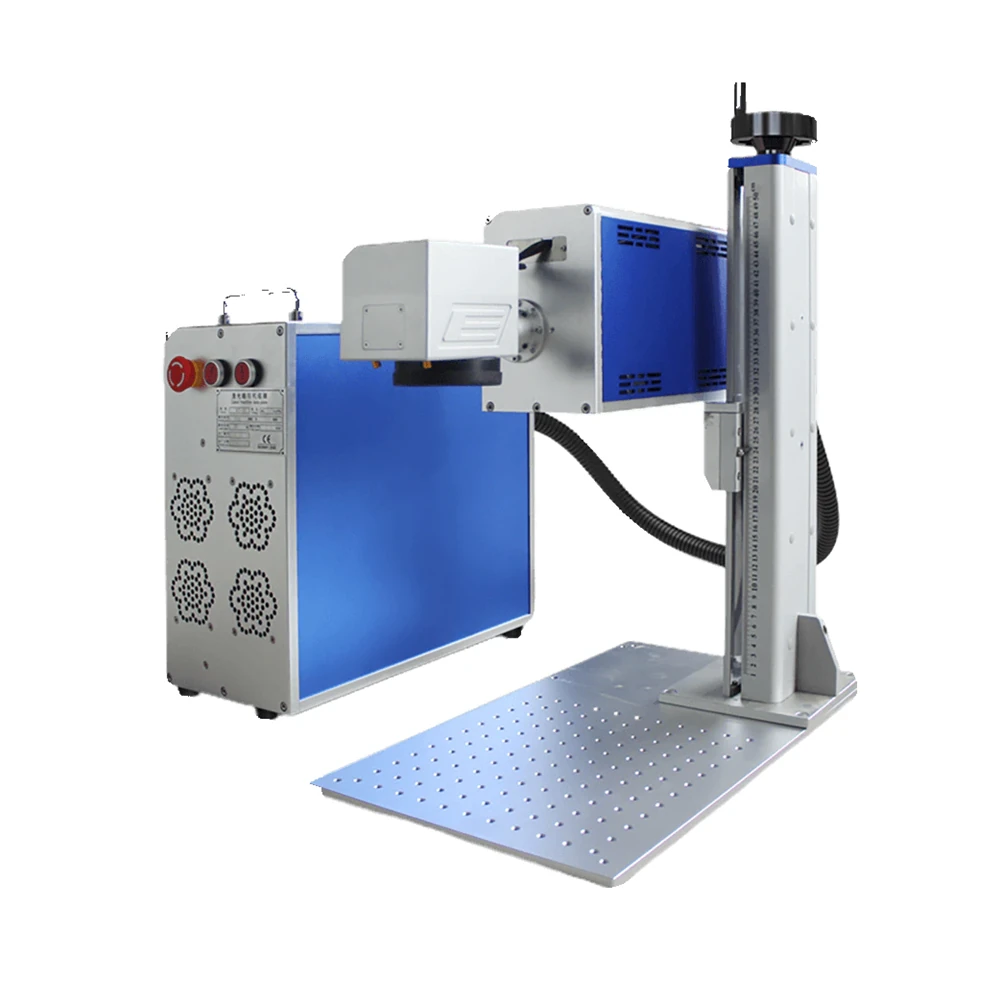
Split-Type CO2 Laser Marking Machine
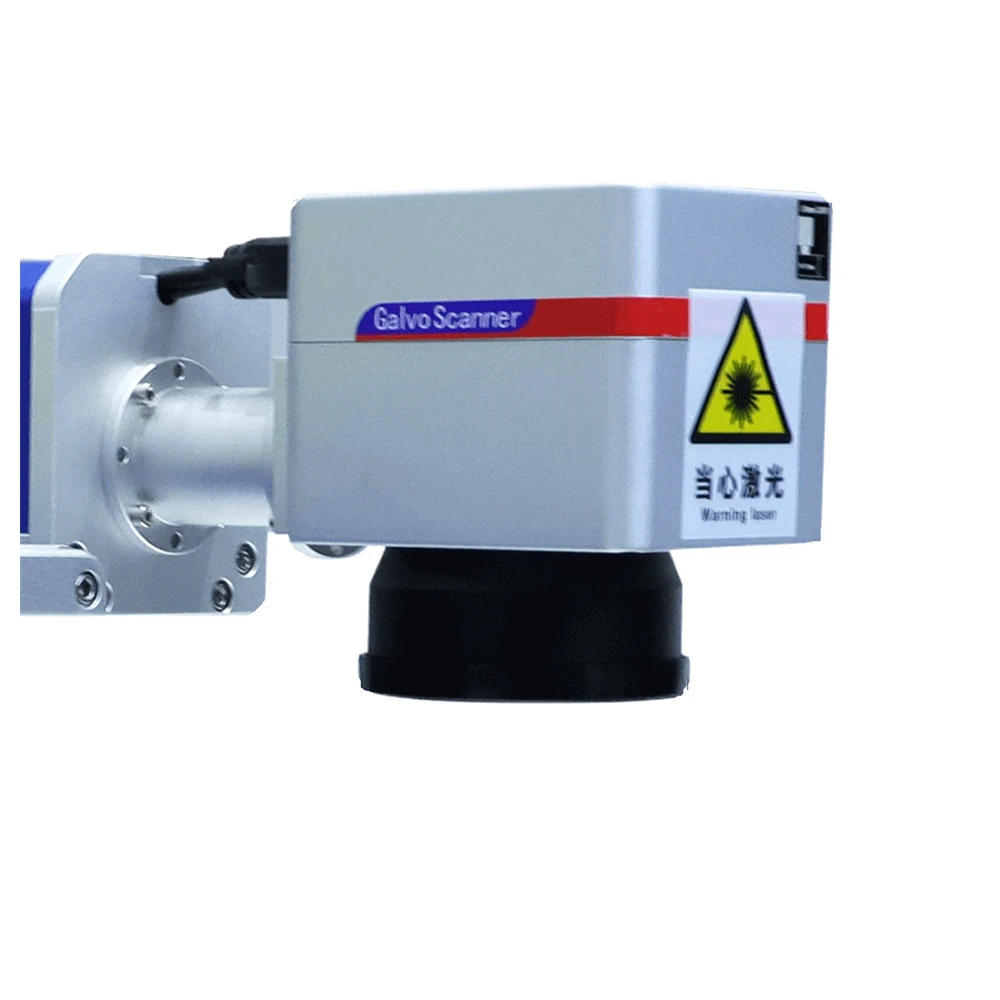
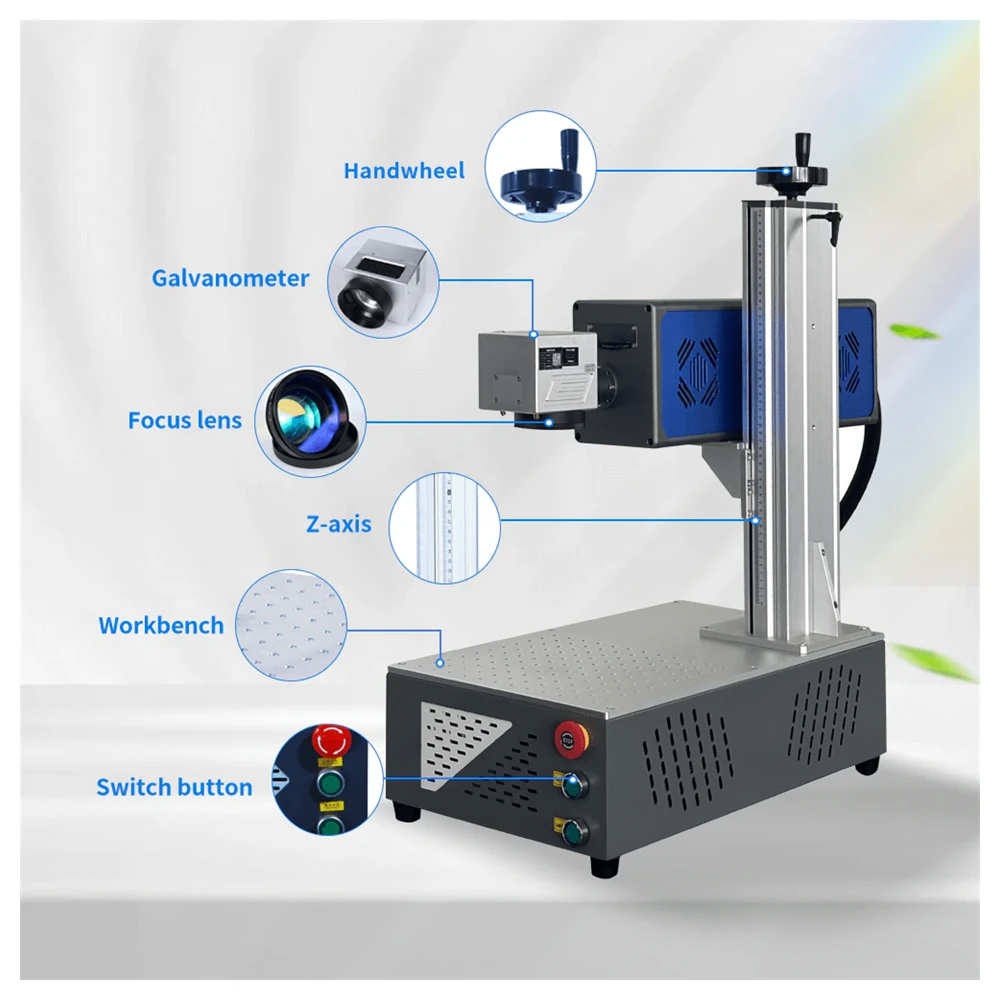
Scanner separated from the cabinet so the head can be placed over a conveyor or a fixed production fixture.
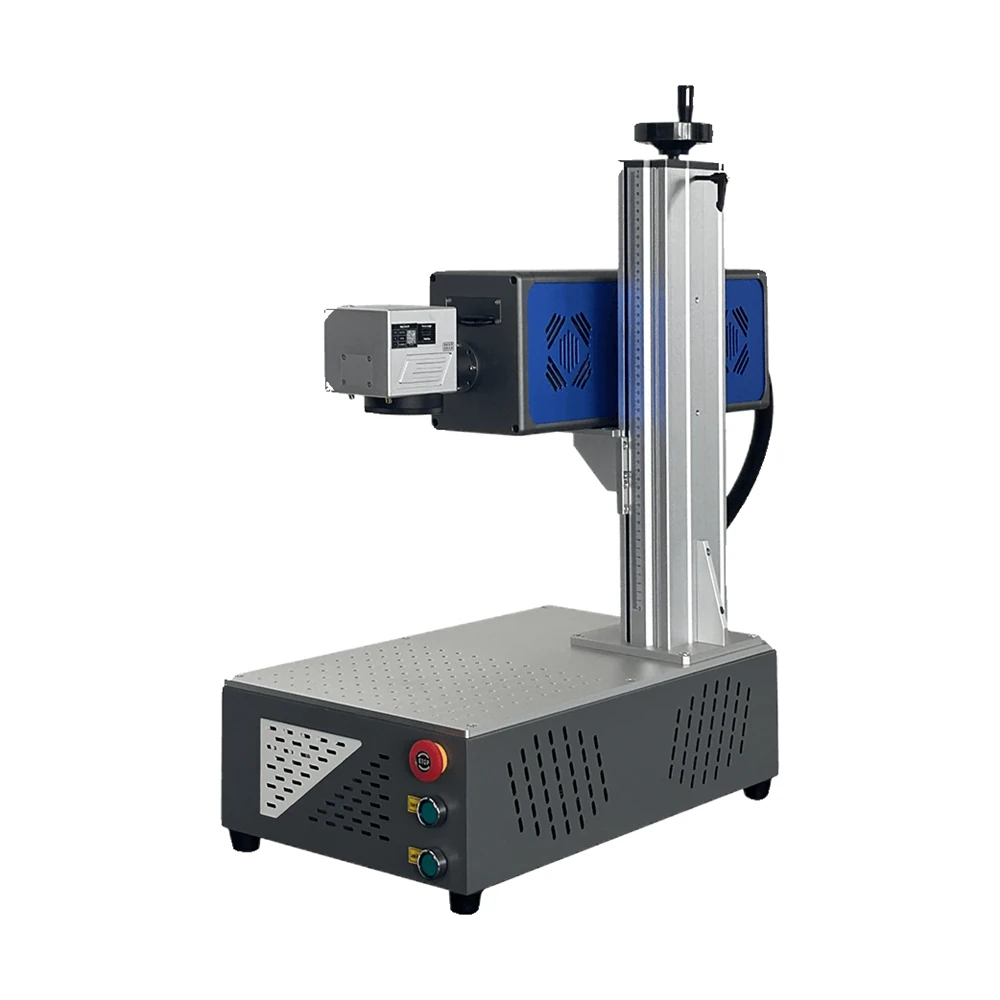
View modelA 10.6 micron beam behaves completely differently from a fiber source. It is absorbed by wood, leather, paper, acrylic, glass, textiles and packaging, and it passes straight through bare metal. This cabinet is built around that fact: one compact body, three power levels and a maintenance-free air-cooled RF tube.
CO2 marking is a matter of absorption. Where the substrate takes the energy, you get a mark; where it reflects or transmits, you get nothing. This is the map operators need before they order.
| Material | Absorption at 10.6 µm | Typical result | Engineering note |
|---|---|---|---|
| Wood and bamboo | Strong | Deep brown to black engraving | The classic CO2 job; depth is set by passes and frequency. |
| Paper and card | Strong | Clean surface mark without cutting | Watch power on thin stock to avoid breakthrough. |
| Leather | Strong | Dark, soft-edged branding | Low frequency keeps edges from charring. |
| Acrylic and PMMA | Strong | Frosted or high-contrast white marking | Produces a bright engraved look on clear sheet. |
| Textiles and felt | Moderate to strong | Discoloured or cut-edge marking | Test weave direction, it changes the mark density. |
| Glass | Moderate | Frosted, matte surface marking | Achieves a soft etched appearance without grit blasting. |
| Ceramics | Moderate to strong | High-contrast permanent mark | 60W gives faster coverage on dense bodies. |
| Coated and painted metal | Coating dependent | Coating ablated to reveal the substrate | Anodised and powder-coated surfaces mark well; bare metal does not. |
| Bare metal | Very low | No usable mark | Use a fiber or MOPA source for bare metal instead. |
Absorption ratings describe the general behaviour of a 10.6 µm source and are intended as a selection guide rather than a guarantee. Contamination, coating thickness and additives shift the result. Send a sample and we will return the marked part with the parameter file we used.
Packaging, textile, craft and industrial product work, all with the same 110 × 110 mm marking window.
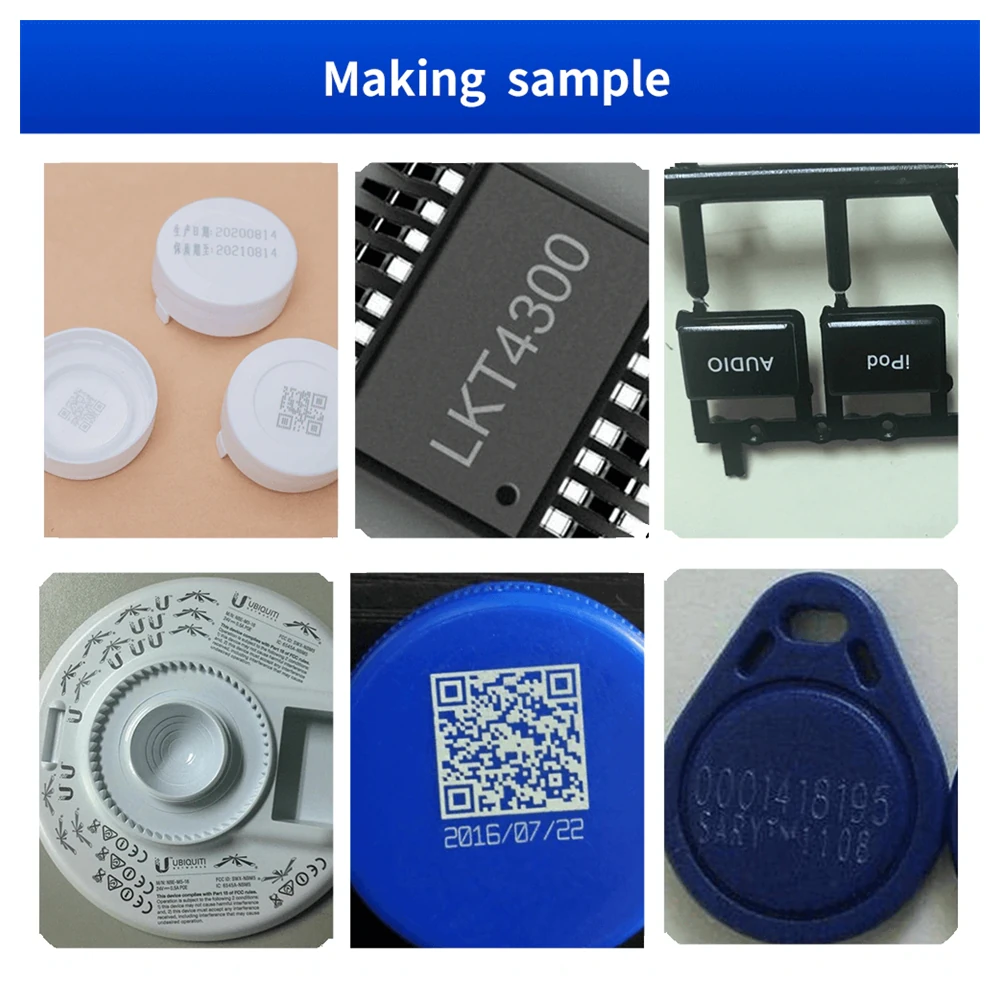
Batch and date codes on cartons, labels and film, marked without ink and without a plate change between jobs.
Logos and size marks on leather panels, denim labels and technical fabrics with a dry, permanent finish.
Bamboo boards, acrylic signage, ceramic ware and decorated items where the mark is part of the product.
All three share the same optics, the same 110 × 110 mm field and the same air-cooled architecture. Power, beam quality and thermal load scale with the model.
| Parameter | KR-AC30 | KR-AC40 | KR-AC60 |
|---|---|---|---|
| Rated Output Power | ≥35W | ≥40W | ≥60W |
| Laser Power Setting | 30W | 40W | 60W |
| Marking Area | 110 × 110 mm | ||
| Laser Source | Davi | ||
| Galvanometer | RC1001 | ||
| Wavelength | 10.6 µm | ||
| Power Stability | <±8% | <±6% | <±6% |
| Beam Quality | Not specified | M² < 1.3 | M² < 1.2 |
| Beam Diameter | Not specified | 1.8 ± 0.2 mm | 1.8 ± 0.2 mm |
| Working Frequency | 0–25 kHz | ||
| Input Voltage | 48 VDC ± 2% | ||
| Maximum Average Current | 12.5A | 12.5A | 25A |
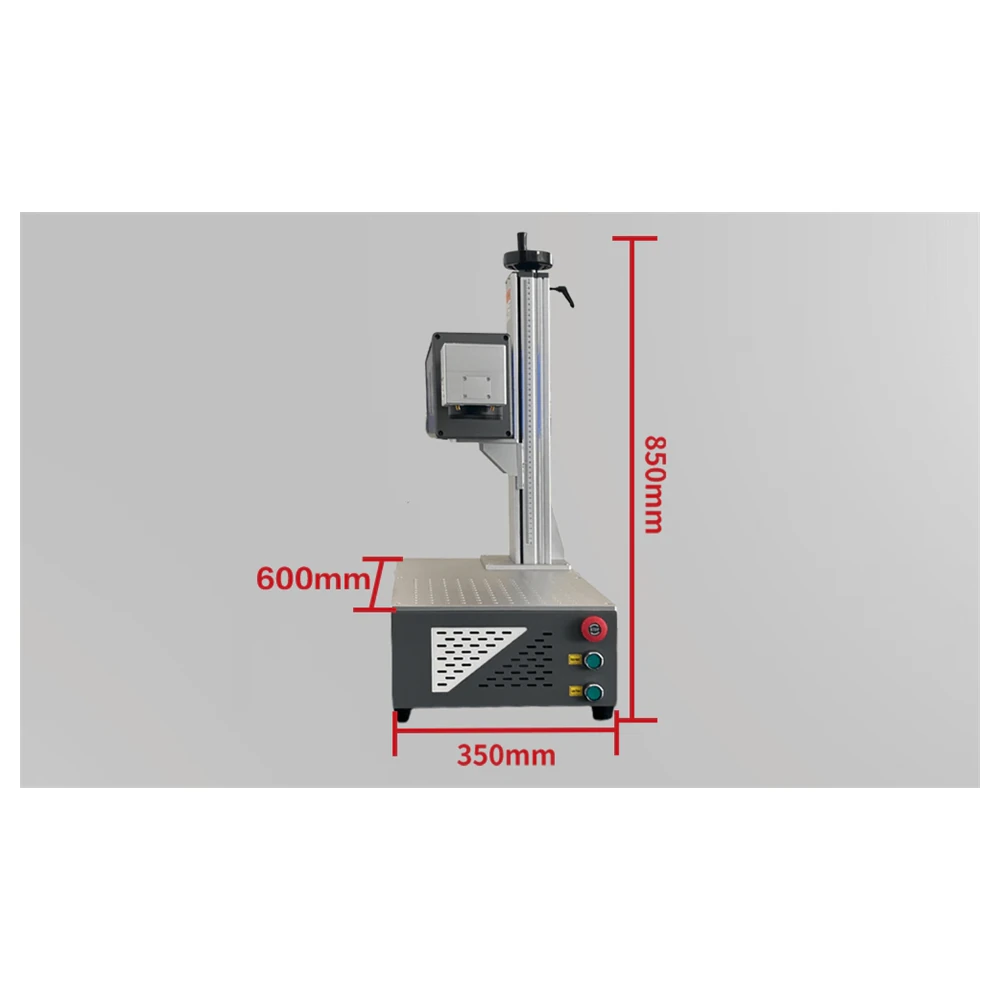
| Thermal Load | <600W | <600W | <1200W |
| Cooling System | Air-cooled, no water circuit | ||
The datasheet leaves beam quality and beam diameter blank for the 30W model; those two rows are shown as not specified rather than estimated. Fume extraction, rotary axes and custom fixtures are quoted per order.
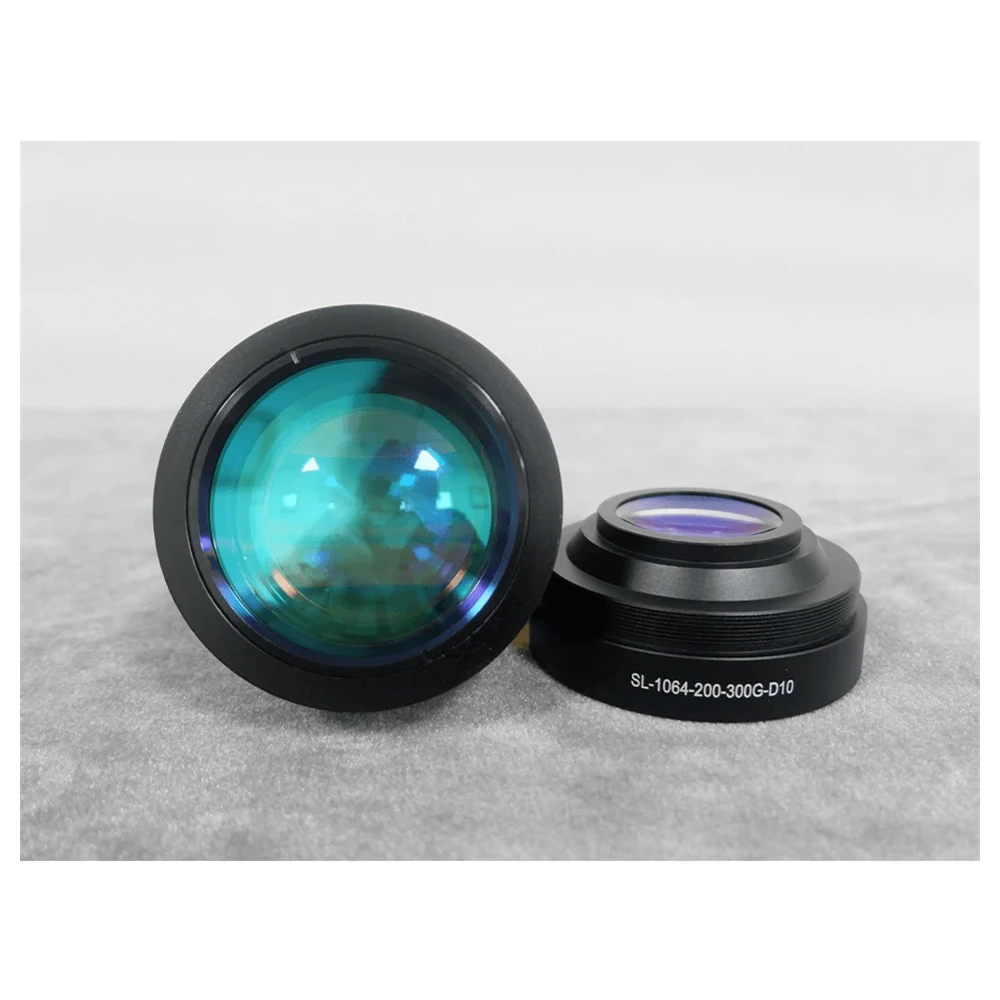
Source, scanner and field lens are matched. Swapping any one of them changes the spot size, the working field and the achievable speed.
Numbers that decide how a CO2 marker behaves on a two-shift or three-shift schedule.
Unlike many CO2 builds there is no water circuit to fill, monitor or freeze, which removes a routine maintenance job entirely.
No inks, solvents or masking films. The running account is electricity, and the marking parameters are stored per job.
A rigid cabinet and a stable resonator keep the beam aligned in environments where the machine is not treated gently.
The all-in-one CO2 laser marker ships in three layers: a plywood outer case for structural protection, foam cushioning that absorbs impact and stops movement in transit, and a thick inner plastic bag that keeps moisture out.
Production normally takes 5 working days. The machine is then sent by air express such as FedEx or TNT, which adds roughly 4 to 6 working days to your location.
Engineers assemble and test every machine before dispatch. Only a few small parts need fitting on arrival, and a detailed training video plus a full English user manual cover operation and setup.
English online support is available through Skype, WhatsApp, WeChat, email and video calls, covering both machine use and software guidance.
Organic and non-metallic materials respond strongest: wood, bamboo, paper and card, leather, textiles, acrylic, glass, ceramics and most packaging substrates. Bare metal reflects the beam, so metals are marked through a coating, paint or anodised layer.
Yes. The laser module is designed for 24-hour continuous operation, which suits packaging lines and engraving shops running extended shifts.
The RF metal tube source is rated for more than 20,000 hours of service, and the air-cooled design removes the water circuit and its maintenance entirely.
Marking wood, leather, rubber and some plastics releases smoke and fine dust. An optional fume extractor is available to keep the working area clean and the air safe for operators.
Same 10.6 µm source, different mounting and different working envelope.
Scanner separated from the cabinet so the head can be placed over a conveyor or a fixed production fixture.
View model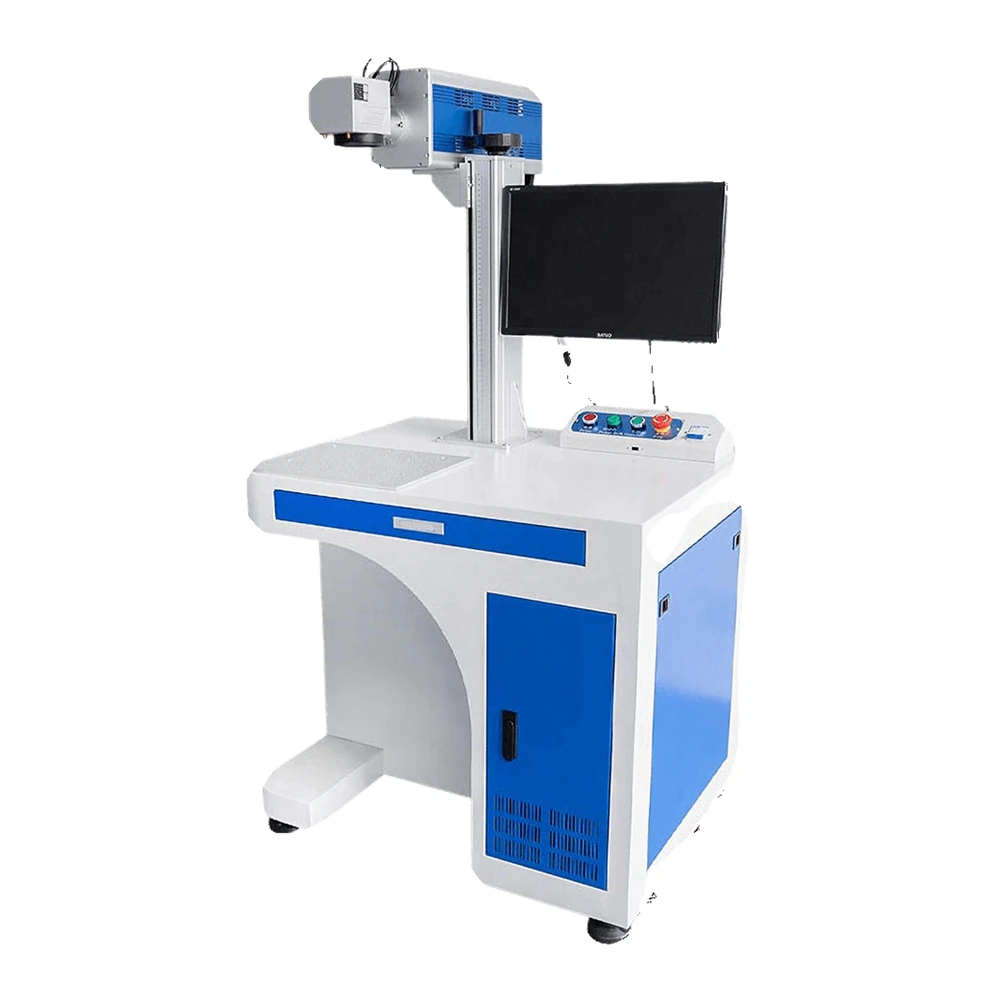
Enclosed cabinet for bench-top work, useful where a small footprint and a protected working area are required.
View model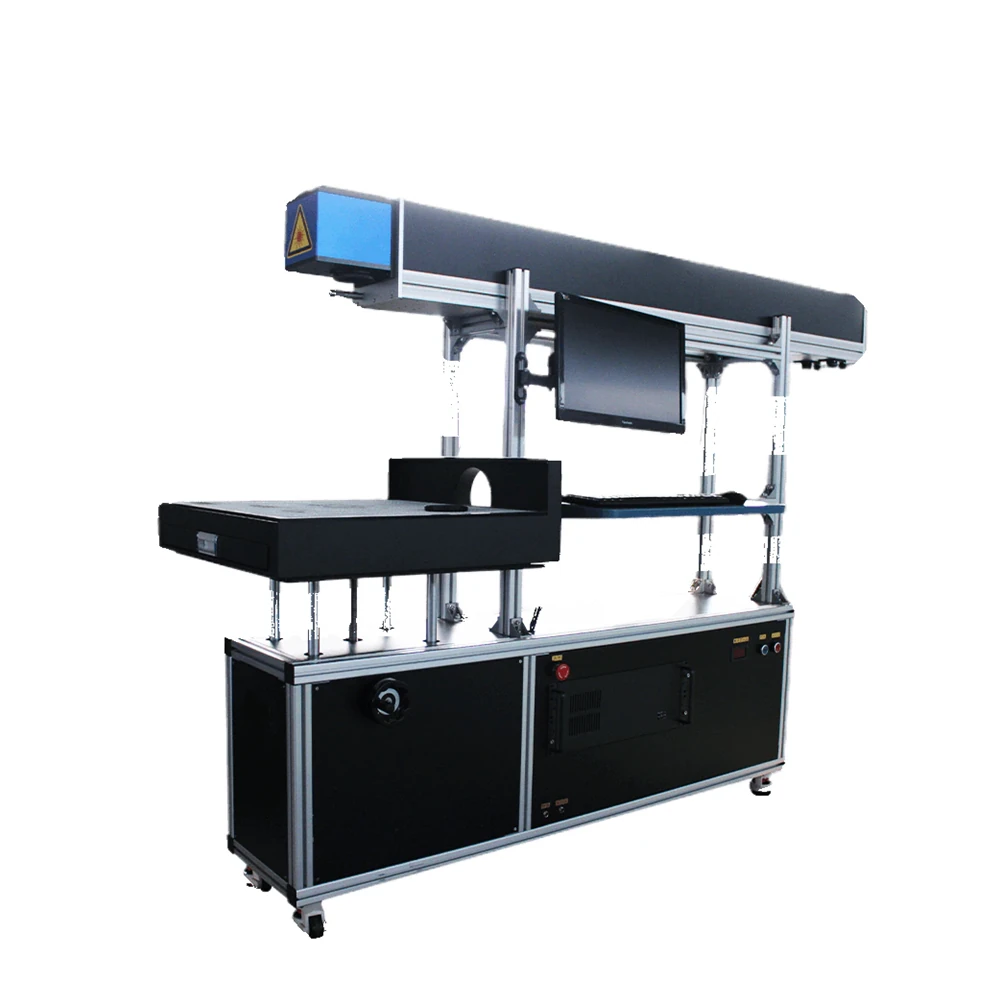
A wider working envelope for full-size panels, boards and printed sheets that exceed a 110 mm field.
View model