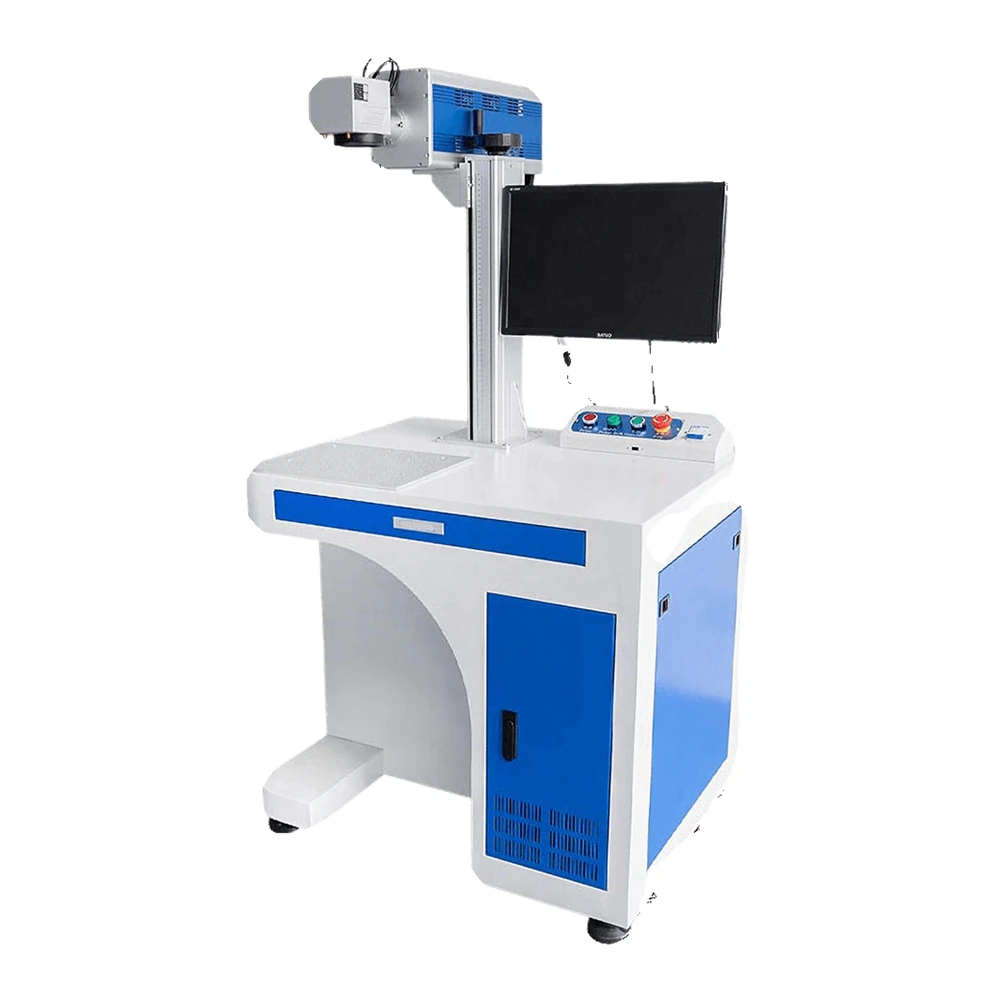
Desktop CO2 Laser Marking Machine
The same CO2 process for parts that can be loaded by hand onto an enclosed bench unit.
View modelThe line keeps running. A 10.64 micron CO2 beam writes dates, batch codes, barcodes and logos onto packaging, textiles, acrylic and wood as they pass the head, in a compact one-piece body with built-in machine lighting.
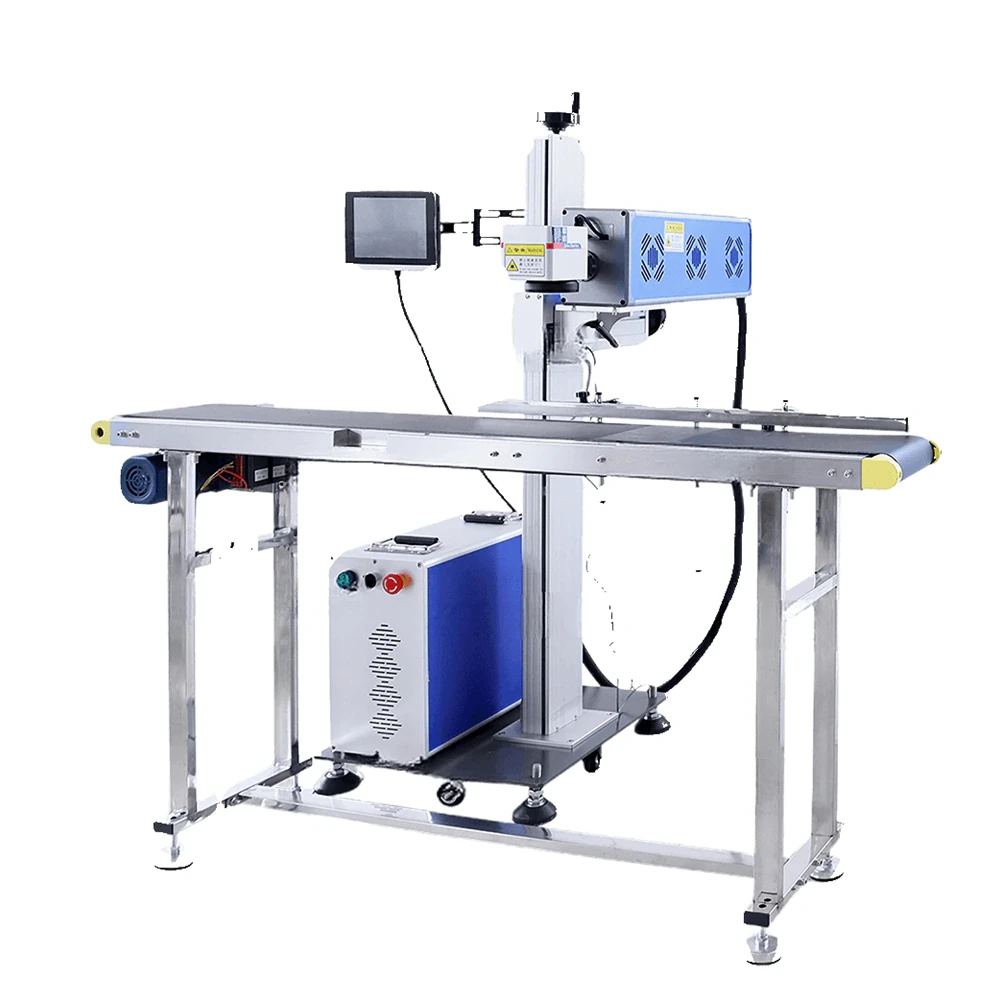
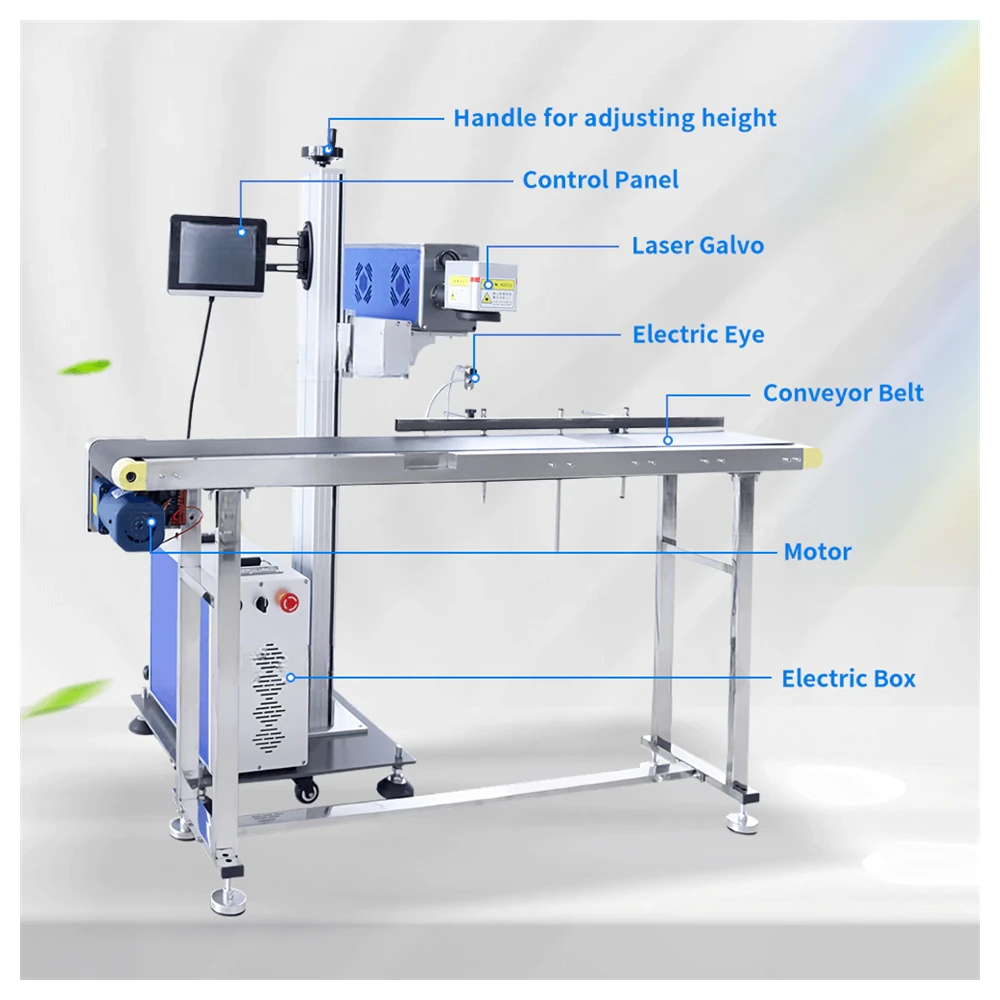
A flying marker has to finish inside the gap between two products. This is the order in which the cabinet does its work, and what each step depends on.
| Stage | What happens | What it depends on |
|---|---|---|
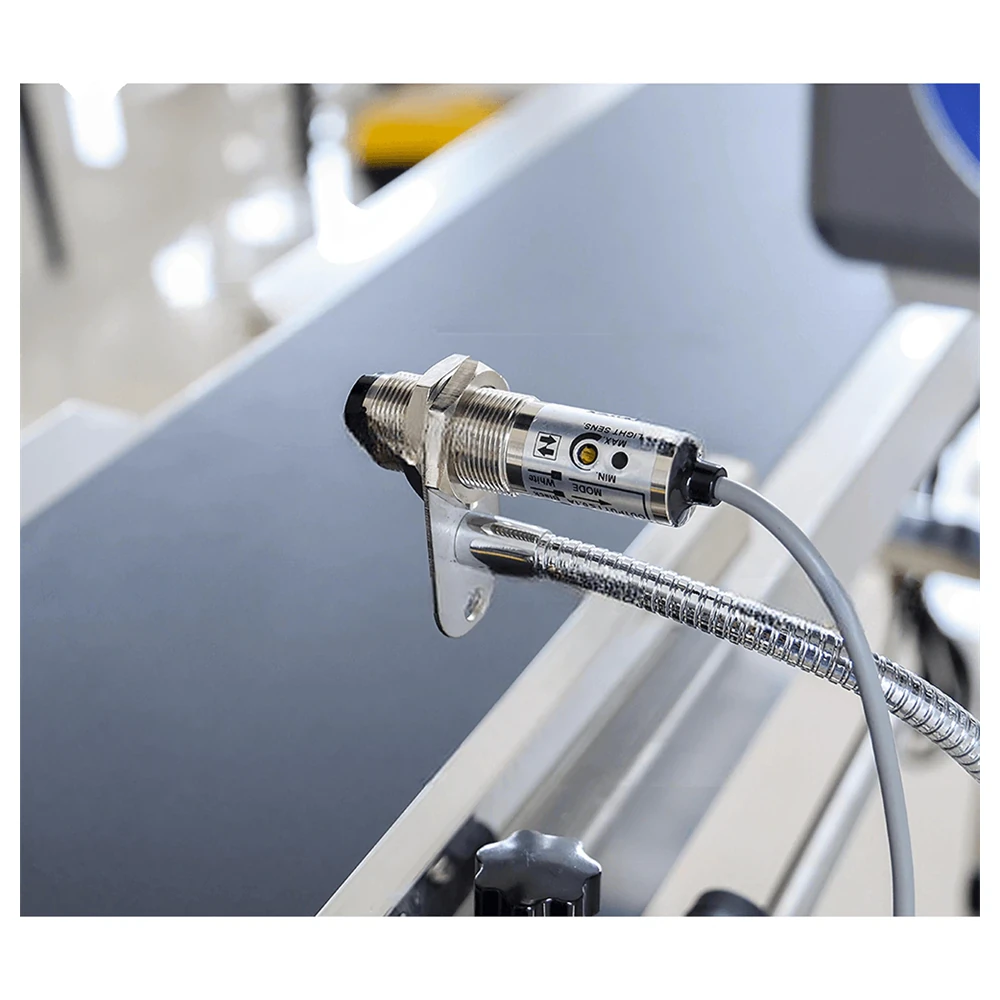
| 1. Product detected | A sensor upstream of the head sees the leading edge of the product and passes a start signal to the controller. | Sensor position and trigger delay setting |
| 2. Speed locked | The controller follows the line speed so the text is written at the right density instead of stretched or squeezed. | Stable conveyor speed |
| 3. Mark written | The scanner writes dates, batch codes, barcodes or logos while the product is still moving past the head. | Marking speed of 10,000 to 12,000 mm/s |
| 4. Mark closed | The program finishes the last vector and releases the axis for the next product. | Character height and code density |
| 5. Cycle reset | The counter advances, the next serial or date is generated automatically and the system waits for the next trigger. | Line pitch and gap between products |
Delivered cycle time depends on the marking area, the code density and the speed stability of your conveyor. Send a video clip of the line at production speed and we will confirm whether the sequence closes inside the gap between products.
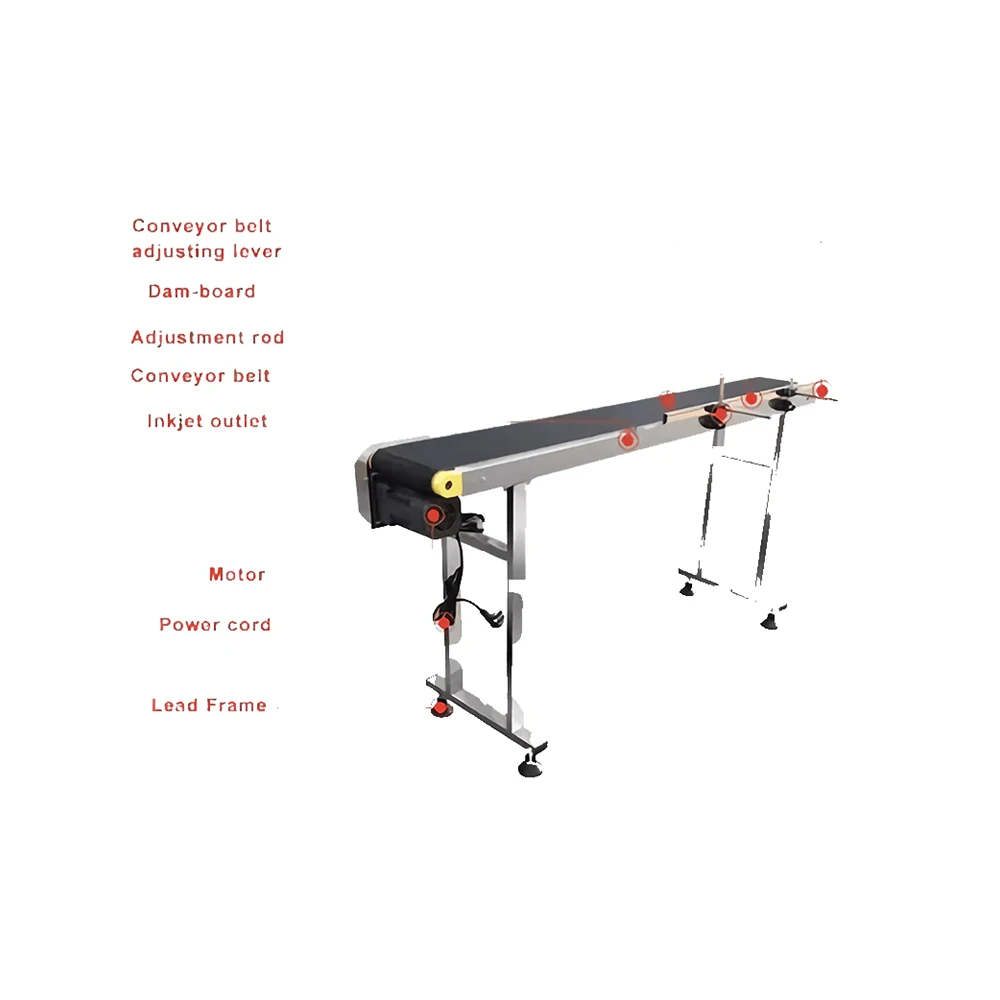
Flying marking is a retrofit project more often than a new line, so the machine is designed to be fitted around equipment that is already running.
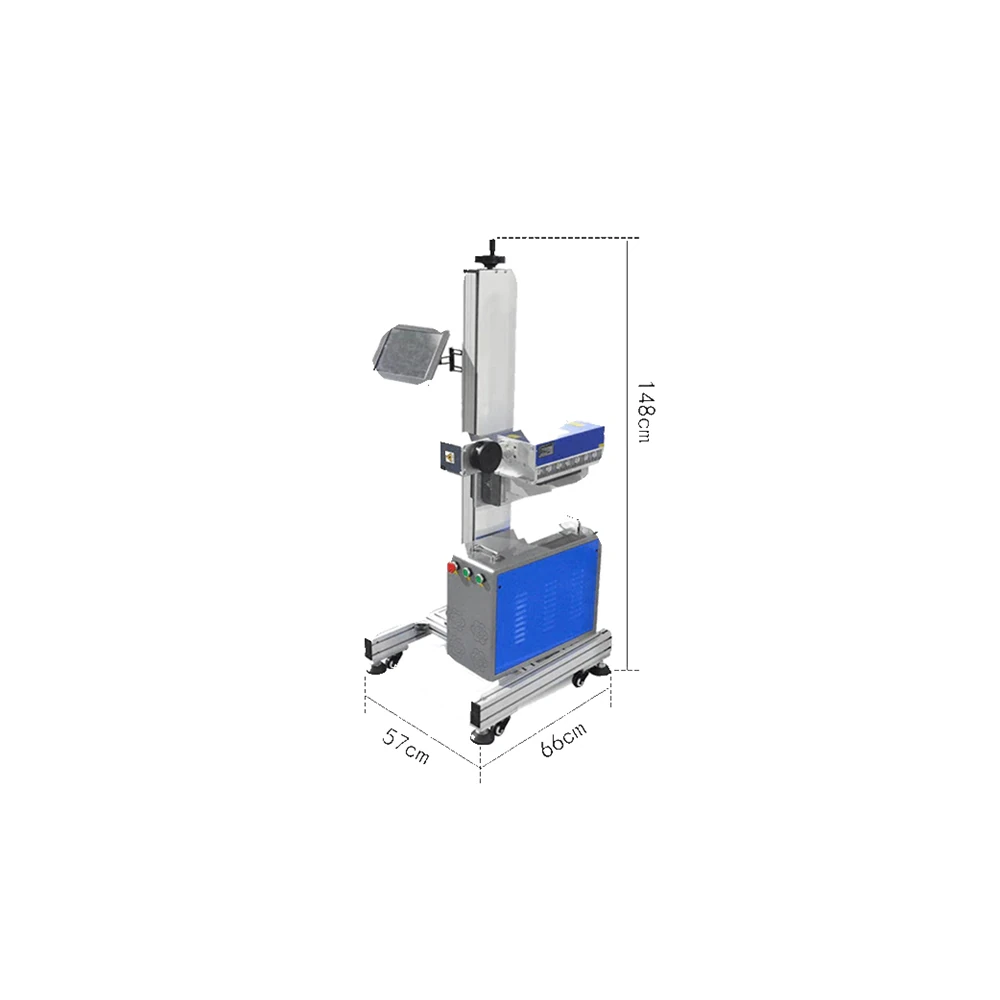
Record the conveyor speed, product pitch and the height available above the product before anything is ordered.
Fit the compact body on its bracket or stand beside the conveyor, so the marking area sits square to the passing surface.
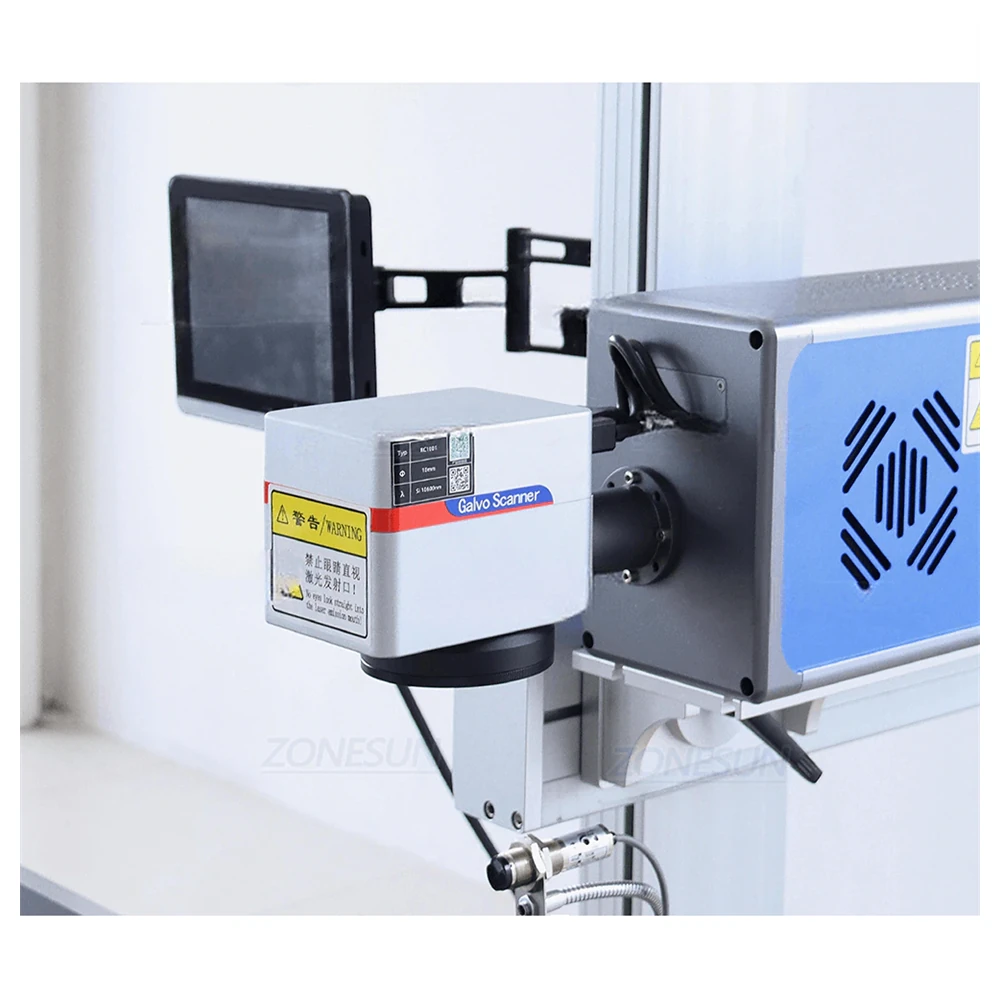
Position the sensor, set the delay and confirm that the same point on every product lands inside the marking area.
Mark a full production run, check contrast and code readability, then hand the job file to the line operator.
A CO2 source is absorbed by organic and polymer surfaces and reflected by bare metal. That single fact decides the whole application list.
| Material | Response to the CO2 beam | Typical mark |
|---|---|---|
| Paper and card | Strong absorption | Brown to black date and batch codes on cartons |
| Coated labels and film | Strong absorption | High-contrast variable data on self-adhesive labels |
| Leather | Strong absorption | Engraved logos and decorative detail |
| Textiles and fabric | Strong absorption | Fine patterns and brand identification |
| Acrylic | Strong absorption | Frosted or deep engraved marks and cut edges |
| Wood and MDF | Strong absorption | Deeper carving, patterns and text |
| Untreated metal | Reflective at this wavelength | Not suitable; a fiber source is required instead |
10.64 microns for general marking of paper, wood and acrylic, and 9.3 microns for films and certain plastics that absorb better at the shorter CO2 line.
Power stability better than plus or minus 1 percent RMS across eight hours, so the first carton and the last carton of a shift look the same.
The 30W and 40W models run air-cooled for simple installation, while the 60W model uses water cooling to hold temperature under continuous duty.
Model codes, output power options and cooling method, exactly as they appear in the machine documentation.
| Parameter | KR-FC30 | KR-FC40 | KR-FC60 |
|---|---|---|---|
| Output Power Options | 30W / 60W / 100W | 30W / 60W / 100W | 30W / 60W / 100W |
| Laser Source | Davi / CRD | Davi / CRD | Davi / CRD |
| Galvanometer | Sino-galvo / ZBTK | Sino-galvo / ZBTK | Sino-galvo / ZBTK |
| Wavelength | 10.64 µm / 9.3 µm | ||
| Beam Quality | M² < 1.3 | ||
| Output Power Range | 10% – 100% | ||
| Output Frequency | 20 kHz – 100 kHz | ||
| Power Stability (8 h) | < ±1% RMS | ||
| Focused Spot Diameter | < 0.01 mm | ||
| Marking Speed | 10,000 mm/s | 10,000 mm/s | 12,000 mm/s |
| Minimum Line Width | 0.012 mm | ||
| Minimum Character Height | 0.1 mm | ||
| Repeat Accuracy | ±0.003 mm | ||
| Cooling Method | Air-cooled | Air-cooled | Water-cooled |
| Working Temperature | 10°C – 35°C | ||
| Working Humidity | 20% – 80% | ||
| Power Supply | 220V/50Hz or 110V/60Hz | ||
| Laser Module Life | 40,000 – 60,000 hours | ||
Two inconsistencies appear in the source documentation. The model codes suggest a 30W, 40W and 60W progression while the technical table lists 30W, 60W and 100W as the available output options for all three models, and the feature list quotes a laser life of 20,000 to 30,000 hours against 40,000 to 60,000 hours in the table. The technical table values are used throughout this page. Confirm the output power you need when ordering.
Four production environments where the marking step has to disappear into the line instead of interrupting it.
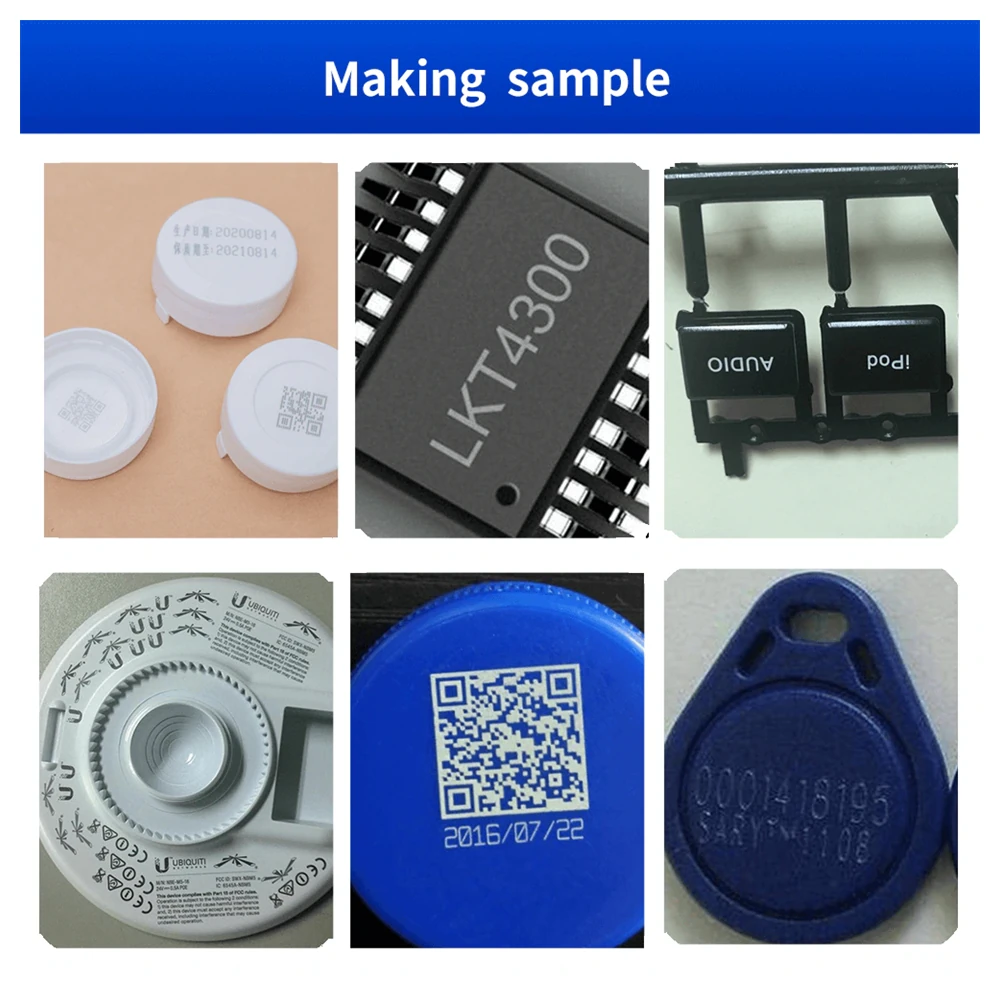
Expiry dates, barcodes and batch numbers applied to cartons, labels and flexible packaging as they come off the filler or the sealer.
Fine patterns and brand identification engraved directly into fabric, adding customisation without a printing plate or a consumable.
Traceability marks on components, boards and connectors, written at production speed so the marking station never becomes the constraint.
Fine engraving, patterns and product information on wooden parts, where the CO2 beam gives depth that a printed label cannot match.
The operator prepares the layout once, then the system generates the variable data for every product without anyone touching the file again.
What arrives with the machine, and how we help while your line is being commissioned.
Air express with DHL, FedEx, TNT or UPS, or air and sea freight for multi-unit projects. Tracking is shared at dispatch.
T/T bank transfer, PayPal and Western Union are accepted. Volume terms are agreed per order and Incoterms are confirmed in writing.
Two years of cover with free replacement parts for any failure in the period, plus lifetime support by email, WhatsApp and remote session.
Remote guidance while the sensor, delay and job file are set up, so the marking station is signed off in one visit instead of several.
It is built for products that keep moving. Instead of placing a part on a bench, the system marks the date, batch, barcode or logo while the item travels along a production line.
A CO2 beam marks the surface of the material as it passes the marking head. The heat changes the colour of the surface or removes a thin layer, leaving a permanent mark on a moving product without stopping the line.
Non-metal materials such as paper, leather, fabric, acrylic, wood, plastic and rubber. Untreated metals do not absorb a 10.64 micron beam and are not suitable for a CO2 source.
Packaging, food, pharmaceutical, textile, electronics, automotive and general manufacturing, marking serial numbers, batch codes, production dates, logos and barcodes.
Marking speed reaches 10,000 mm/s on the 30W and 40W models and 12,000 mm/s on the 60W model, and the control software engraves up to 800 standard characters per second.
The technical table gives a laser module life of 40,000 to 60,000 hours depending on use. An air-cooled design and low maintenance needs keep the machine in service with very little downtime.
The machine runs on 220V/50Hz or 110V/60Hz depending on the model and configuration, with 30W, 60W or 100W output options and an output frequency range of 20 kHz to 100 kHz.
Repeat accuracy is plus or minus 0.003 mm with a minimum line width of 0.012 mm and a minimum character height of 0.1 mm, so dense codes and small text stay readable on a moving product.
If the product can be carried to a bench, or if the print area is wider than a single head can cover, these formats are worth comparing.
The same CO2 process for parts that can be loaded by hand onto an enclosed bench unit.
View model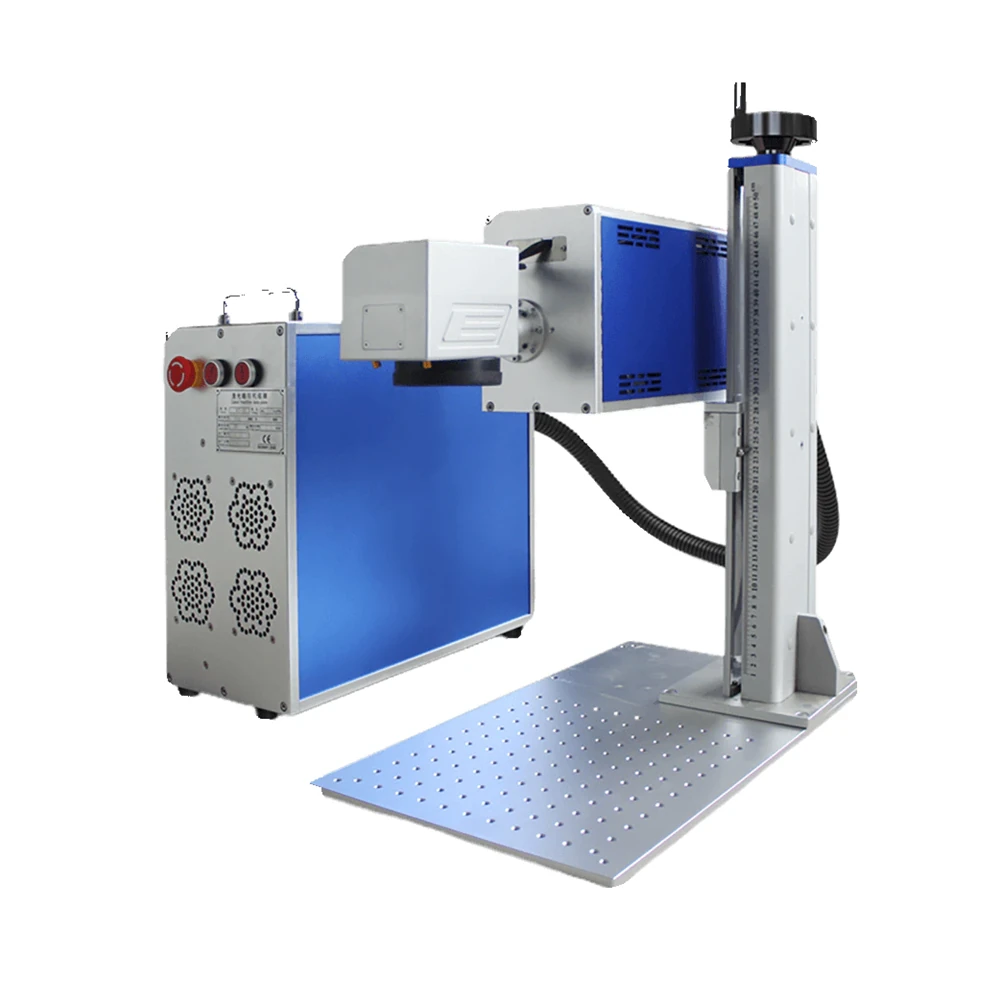
Head separated from the cabinet, which suits fitting the marking unit into an existing machine frame.
View model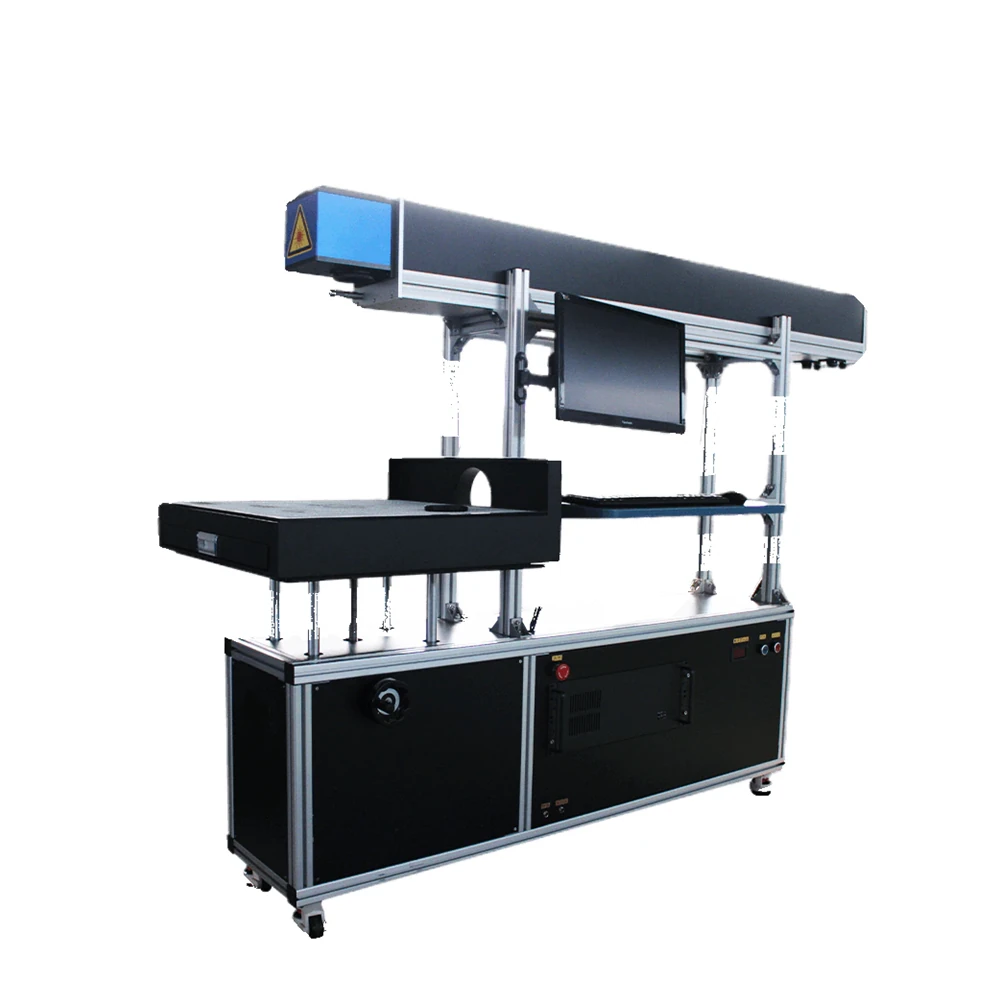
A wider working field for large panels and boards that would need several passes on a standard head.
View model