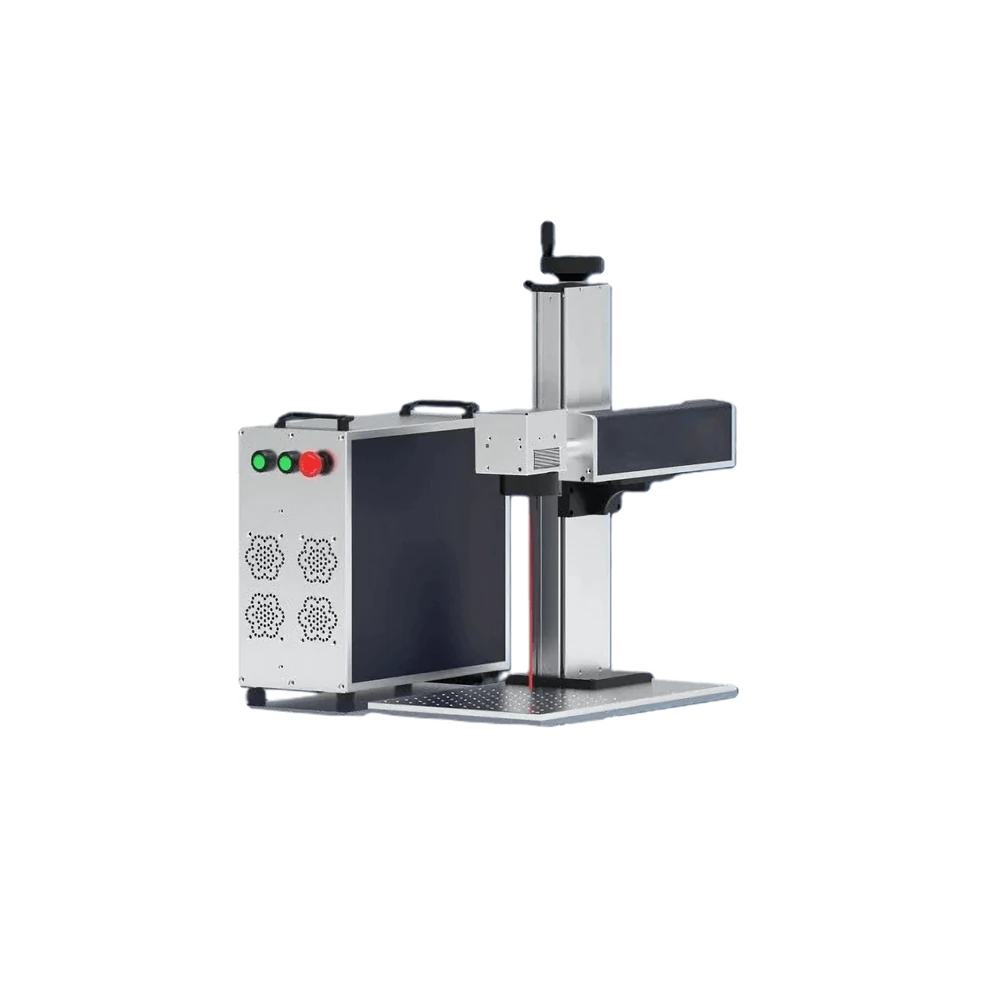
Split-Type Laser Marking Machine
A marking head on a cable for gantry, robot or conveyor mounting where a fixed line frame is not wanted.
View modelA camera watches the product, an encoder measures how far it has travelled, and the 1064 nm beam writes the code before the part leaves the field. Barcodes, QR codes, serial numbers and logos on a line that never has to stop.
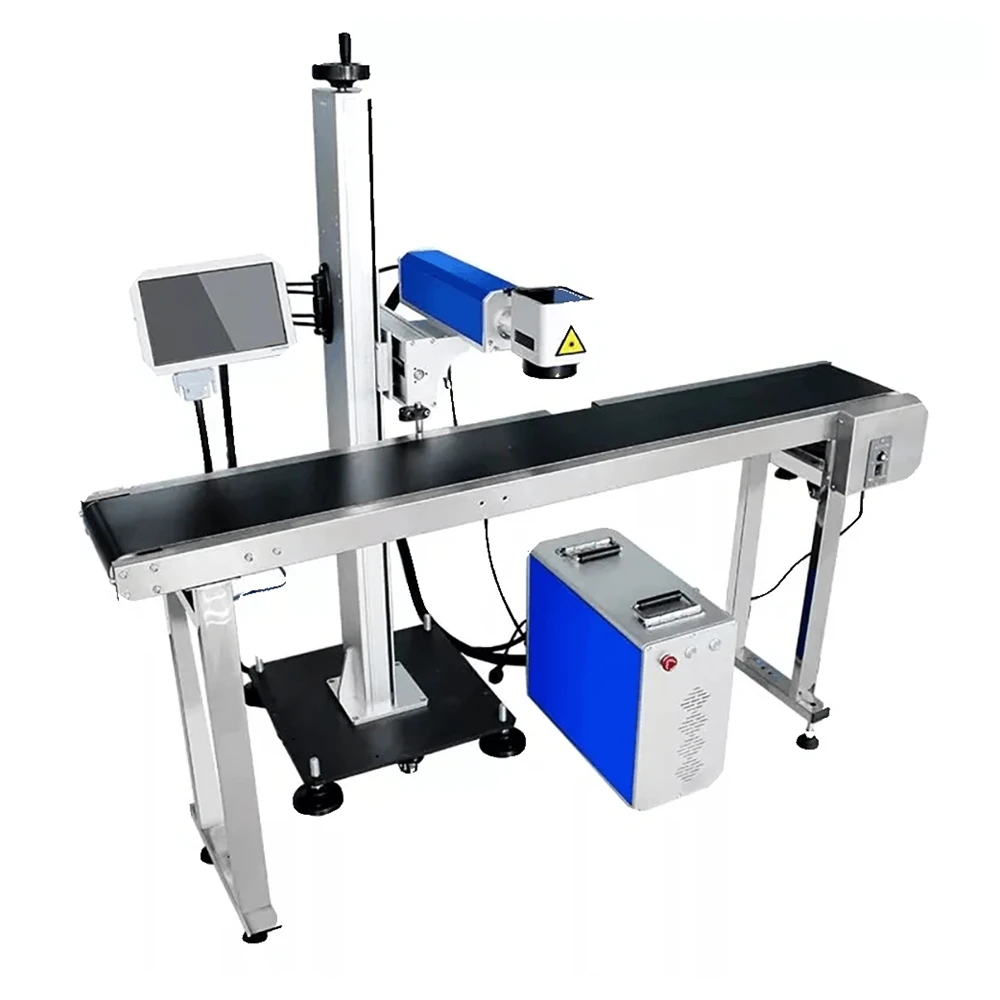
On a fast line the product is never perfectly where the drawing says it should be. The vision system measures that difference and corrects the mark instead of asking the mechanical guide to be perfect.
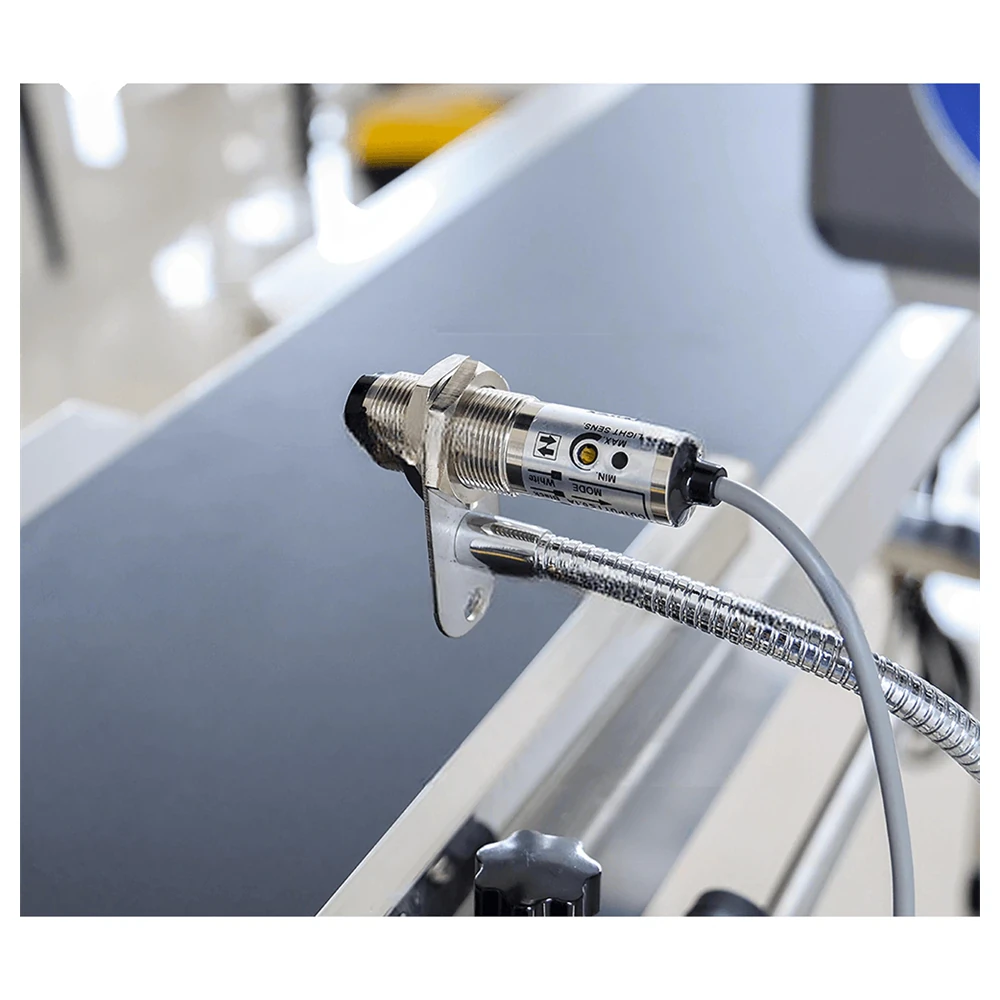
Two signals drive the whole cycle: the sensor that says a product has arrived, and the encoder that says how far it has moved since.
| Signal | Where it comes from | What the controller does with it |
|---|---|---|
| Product trigger | Photoelectric sensor on the infeed side of the head | Starts the delay counter and arms the marking job |
| Encoder pulse train | Rotary encoder coupled to the conveyor drive | Converts pulses into product travel, so the mark is positioned by distance and not by time |
| Speed compensation | Encoder frequency compared with the job length | Scales the output so character density stays constant when the line is accelerated or slowed |
| Vision offset | Industrial camera image of the workpiece | Applies the measured X, Y and angle correction to the job before the beam fires |
| Job advance | Controller counter after the mark is complete | Generates the next serial number, batch code or date and returns to the wait state |
Because the job is driven by encoder pulses, a change in line speed moves the mark with the product rather than leaving it behind.
Marking happens while the conveyor runs. There is no index station, no clamp and no queue building up ahead of the marker.
Serial numbers, batch codes and dates advance automatically with each trigger, so no operator has to type a value between products.
The frame, conveyor and vision hardware are common to the range. Output power is the variable.
| Parameter | KR-FLY20 | KR-FLY30 | KR-FLY50 | KR-FLY60 |
|---|---|---|---|---|
| Output Power | 20W | 30W | 50W | 60W |
| Net Weight | About 220 kg | About 220 kg | About 220 kg | About 225 kg |
| Marking Speed | 0–7,000 mm/s | 0–7,000 mm/s | 0–7,000 mm/s | 0–7,000 mm/s |
| Marking Area | 100 × 100 mm to 300 × 300 mm | |||
| Laser Wavelength | 1064 nm | |||
| Modulation Frequency | 20 kHz – 80 kHz | |||
| Minimum Character | 0.1 mm | |||
| Minimum Line Width | 0.01 mm | |||
| Repeat Accuracy | 0.003 mm | |||
| Resolution | 0.001 mm | |||
| Machine Dimensions | 3980 × 800 × 1300 mm | |||
| Conveyor Length | 1.5 m standard, customisable | |||
| Lifting Column Travel | 500 mm, customisable | |||
| Cooling System | Air-cooled | |||
| Working Environment | 0–35°C, humidity up to 90% | |||
| Working Voltage | 0.5 kW / AC 220V / 50Hz (optional) | |||
Conveyor length, lifting column travel and working voltage are all open to configuration. Send the product height, the line height and the code content and we will confirm the frame layout before the order is placed.
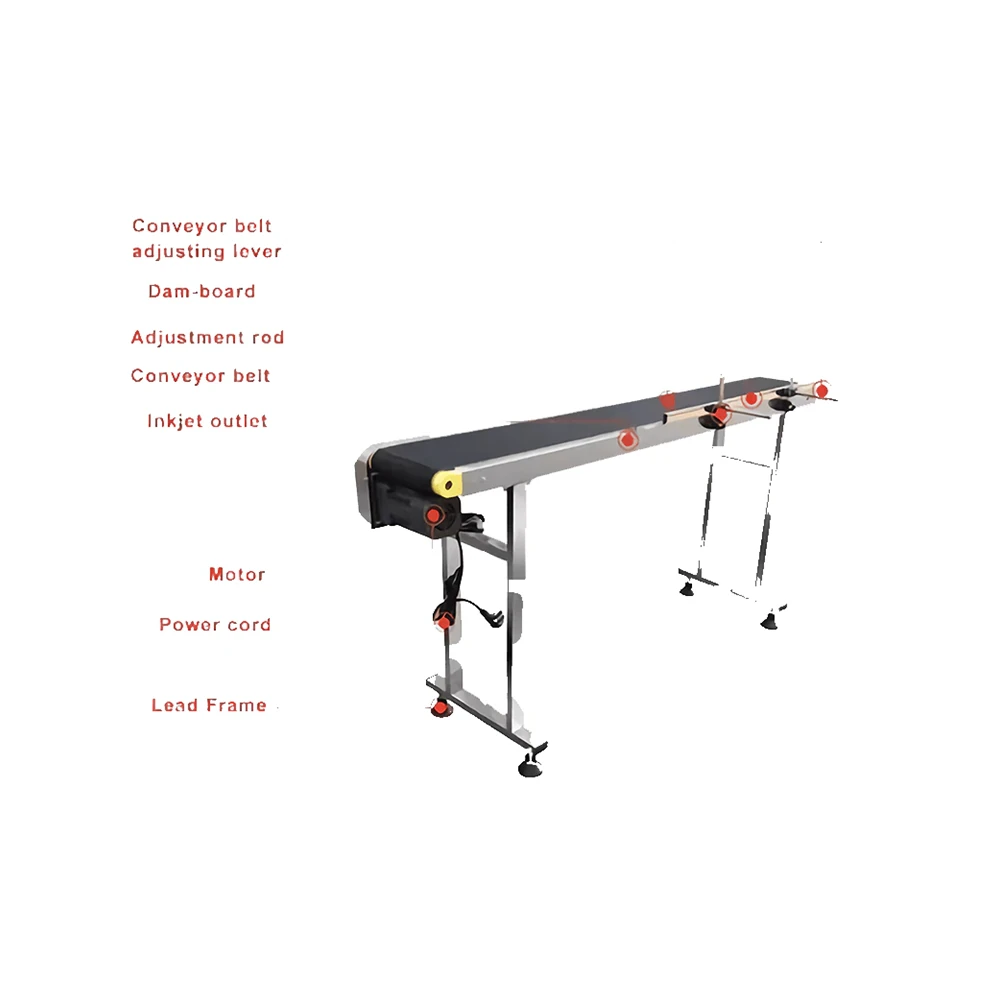
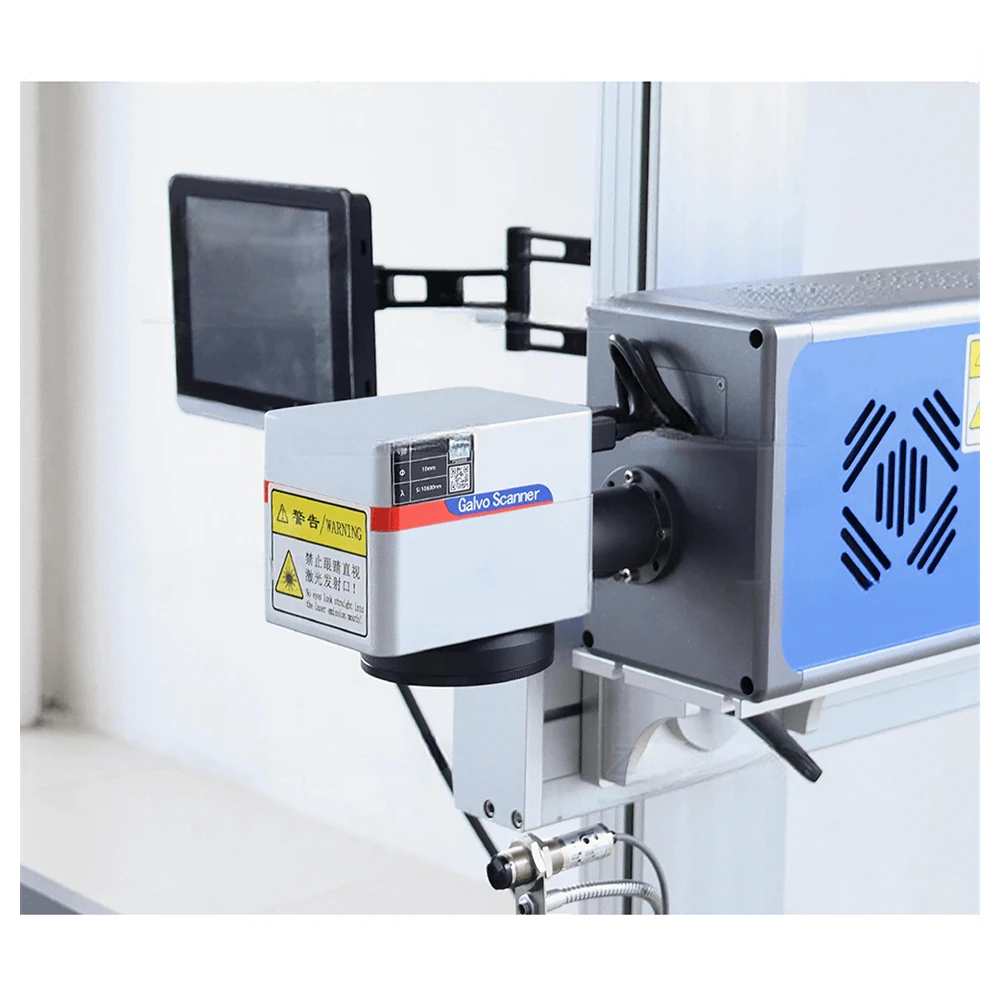
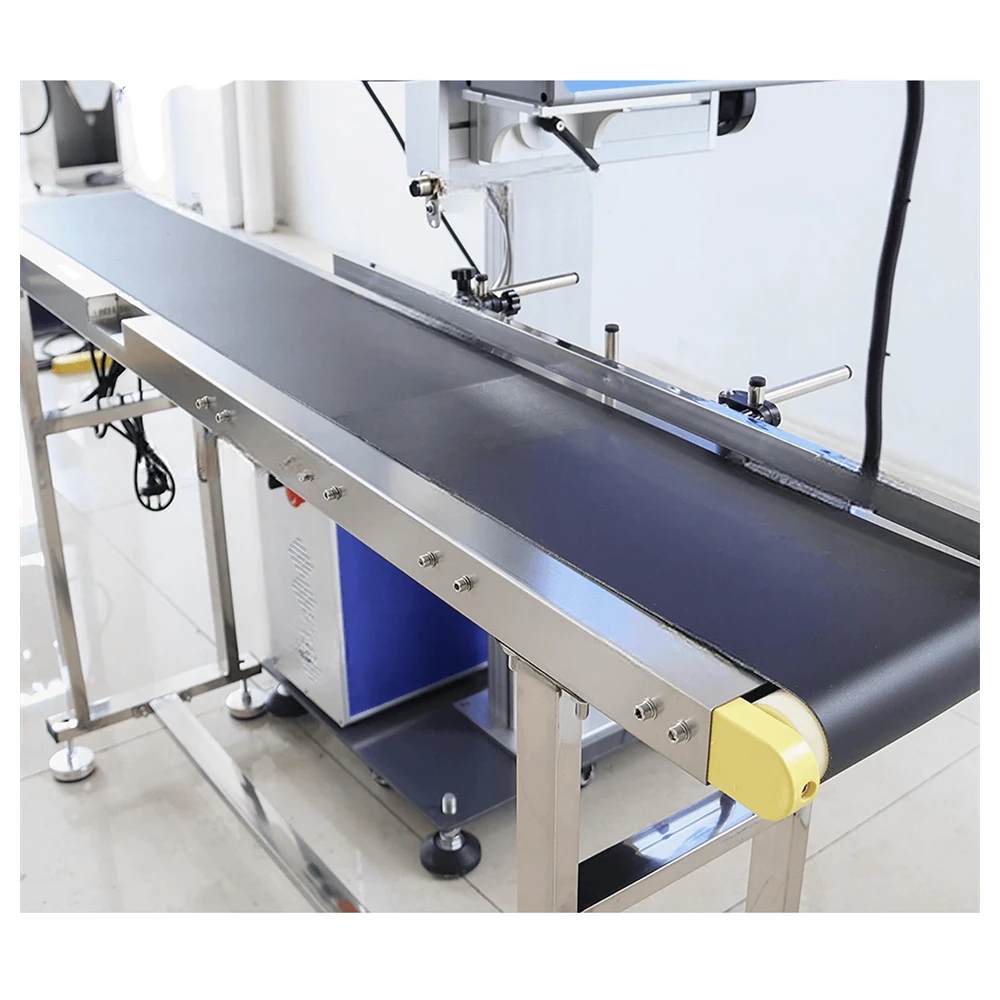
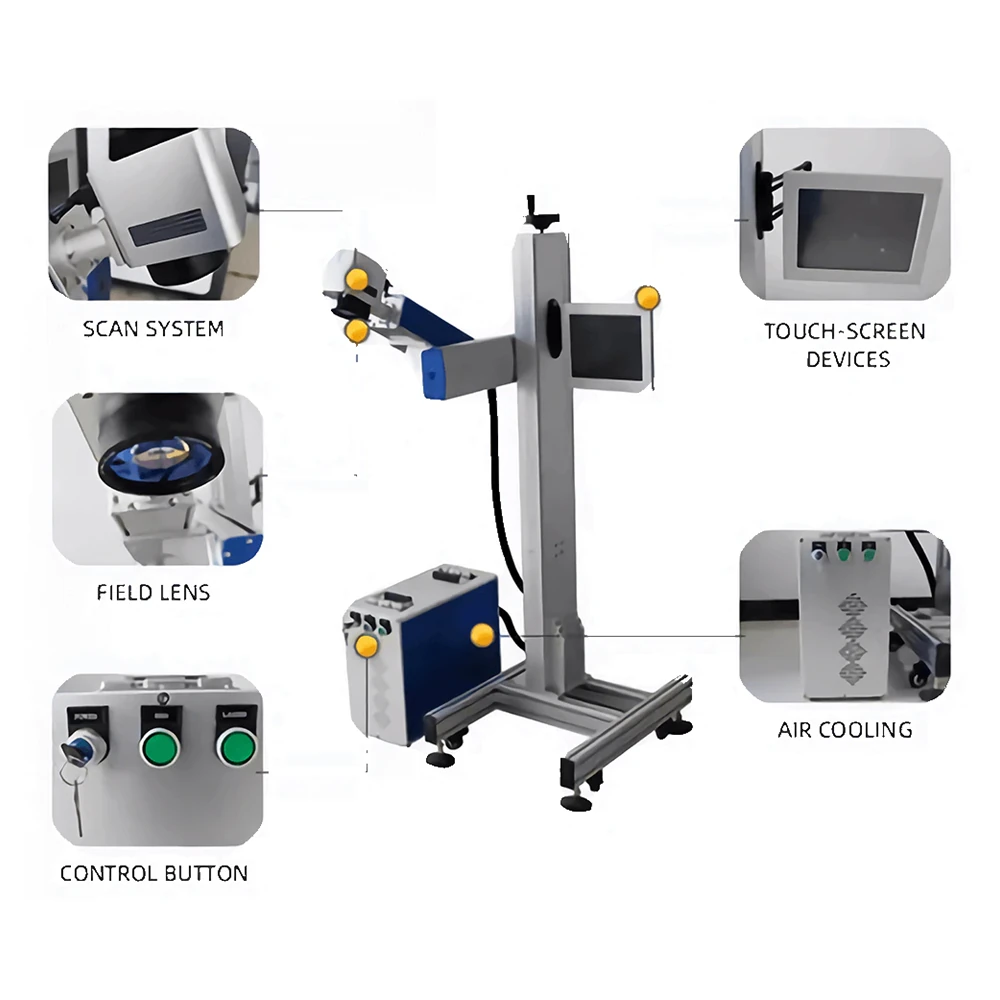
Four sub-systems do the work: the belt that carries the product, the camera that finds it, the scanner that marks it and the source that powers the beam.
The belt moves in step with the marking head and its speed is adjustable, so the marking rhythm matches the rest of the line.
A high-resolution camera takes dynamic images of every workpiece and feeds the offset back to the marking job.
Fast area scanning covers a large field in a short cycle, and the even power distribution across that field removes the inconsistency that speed changes usually cause.
A rugged 1064 nm source with a theoretical life of 100,000 hours, no ink or cartridge consumables and no water circuit to maintain.
Where products are small, numerous and regulated, marking has to be fast, permanent and traceable at the same time.
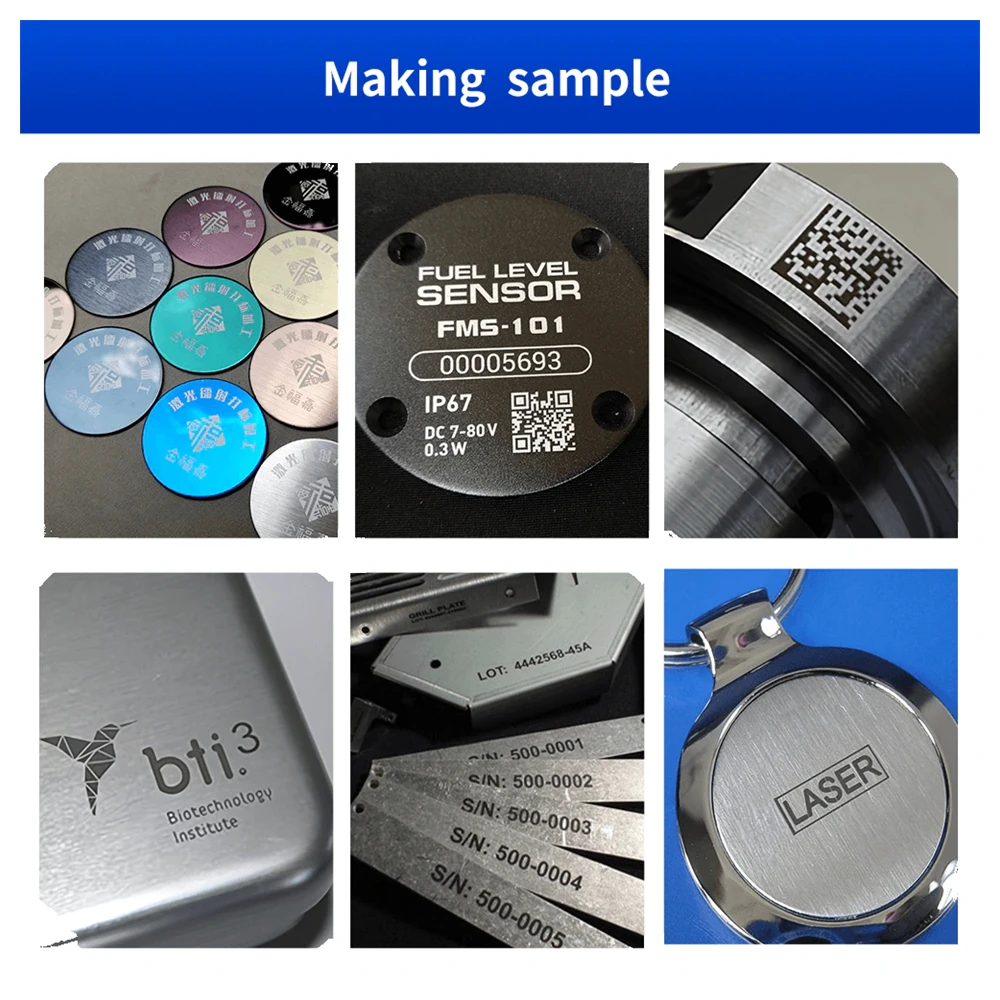
Shelf life dates, batch numbers and QR codes applied to bottles, cans and cartons while they travel between filling and packing.
Dosage information, barcodes and serial numbers on drug packaging, where the mark has to survive handling and stay fully traceable.
Serial numbers, logos and technical specifications on components and devices, applied without contact so small sensitive parts are not damaged.
Permanent identification for parts that are exposed to heat or corrosive environments and must remain traceable for their whole service life.
An inline marker is a project, not a purchase. These are the four stages we work through with your production and maintenance teams.
We record conveyor speed, product pitch, product geometry and the code content so the frame and field size can be fixed before manufacture.
Your product is marked on the same laser configuration, and the settings and readability results are returned with the sample.
The frame is positioned, the sensor and encoder are connected, the vision reference is taught and the first codes are verified.
The job file is locked, the operator is trained on job recall and cleaning, and remote help stays open through the ramp-up.
The machine is supplied as a working line section, not a box of parts to be adapted on site.
Air express with DHL, FedEx, TNT or UPS, and air or sea freight for full line projects. Tracking is issued as soon as the frame is dispatched.
T/T bank transfer, PayPal and Western Union are accepted. Volume terms are agreed per order and delivery terms are confirmed in writing.
Two years of cover with free replacement parts for any failure in the period, and lifetime support by email, WhatsApp and remote session.
The control software is designed to join an existing line control system, and the marking station can be operated from a computer or a mobile device.
A sensor detects the leading edge of each product and a rotary encoder on the conveyor reports how far the product has travelled. The controller marks by distance rather than by time, so if the line speeds up or slows down the mark stays in the same position.
A high-resolution industrial camera captures dynamic images of the workpiece and reports any coordinate offset, which keeps marking accuracy stable across the run. Because the image is checked in real time, position deviations and defects are spotted early so the part can be corrected or rejected before more value is added.
Yes. The machine can recognise and mark multiple items in the same cycle, which raises output and reduces the labour needed at the marking station.
Metals, plastics and ceramics are the main families, which covers pharmaceutical packaging, food and beverage containers, electronic parts and automotive components.
The software is designed for integration with an existing line control system. Automatic sensors and a rotary encoder handle the automatic operation, and the machine can be controlled from a computer or a mobile device.
The frame measures 3980 x 800 x 1300 mm and weighs about 220 kg, or about 225 kg for the 60W model. The conveyor is 1.5 m as standard and can be customised, and the lifting column has 500 mm of travel, also customisable.
Resolution is 0.001 mm, repeat accuracy is 0.003 mm, the minimum line width is 0.01 mm and the minimum character is 0.1 mm. Marking speed reaches 7,000 mm/s and the laser modulation frequency range is 20 kHz to 80 kHz.
The system draws about 0.5 kW at AC 220V/50Hz, with other voltages available as an option. Cooling is air-based, and the working environment range is 0 to 35 degrees Celsius with humidity up to 90 percent.
If the marking does not have to happen on a conveyor, one of these formats usually costs less to own and to set up.
A marking head on a cable for gantry, robot or conveyor mounting where a fixed line frame is not wanted.
View model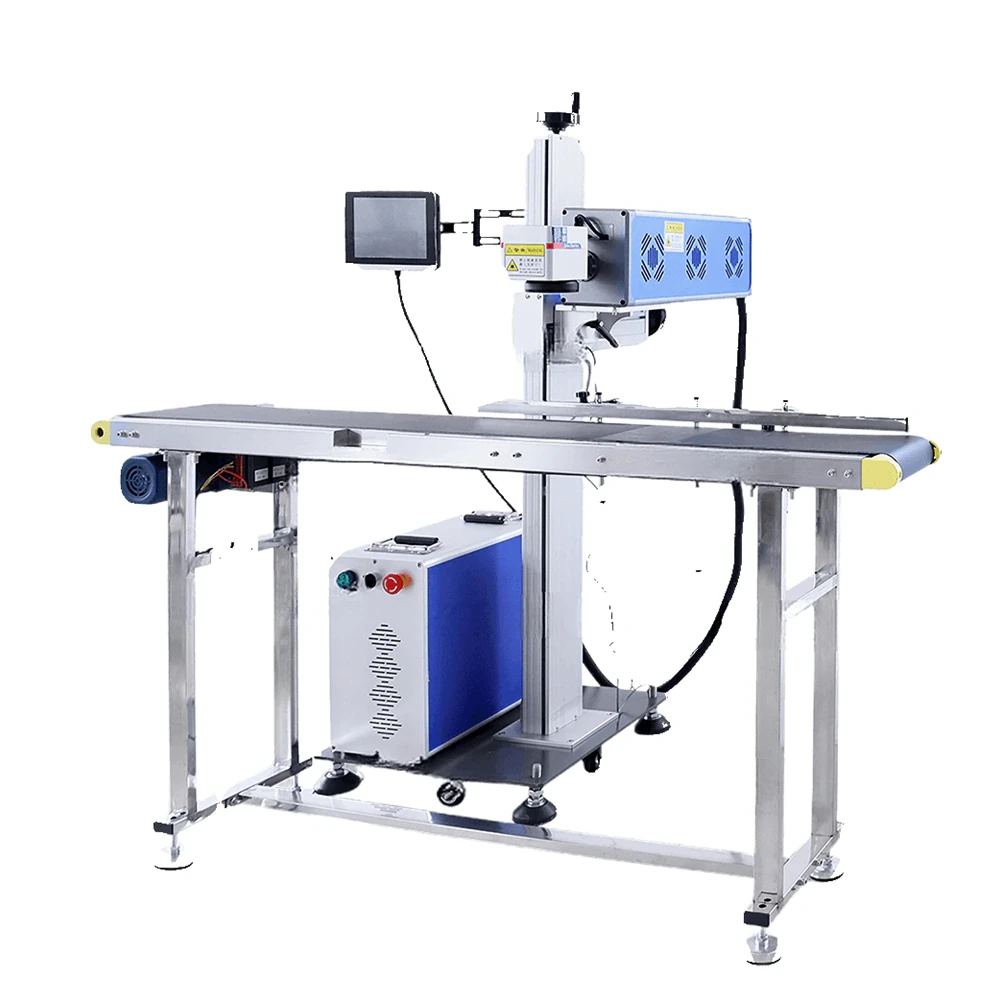
The same on-the-fly principle with a CO2 source for paper, film, textile and wood instead of metal parts.
View model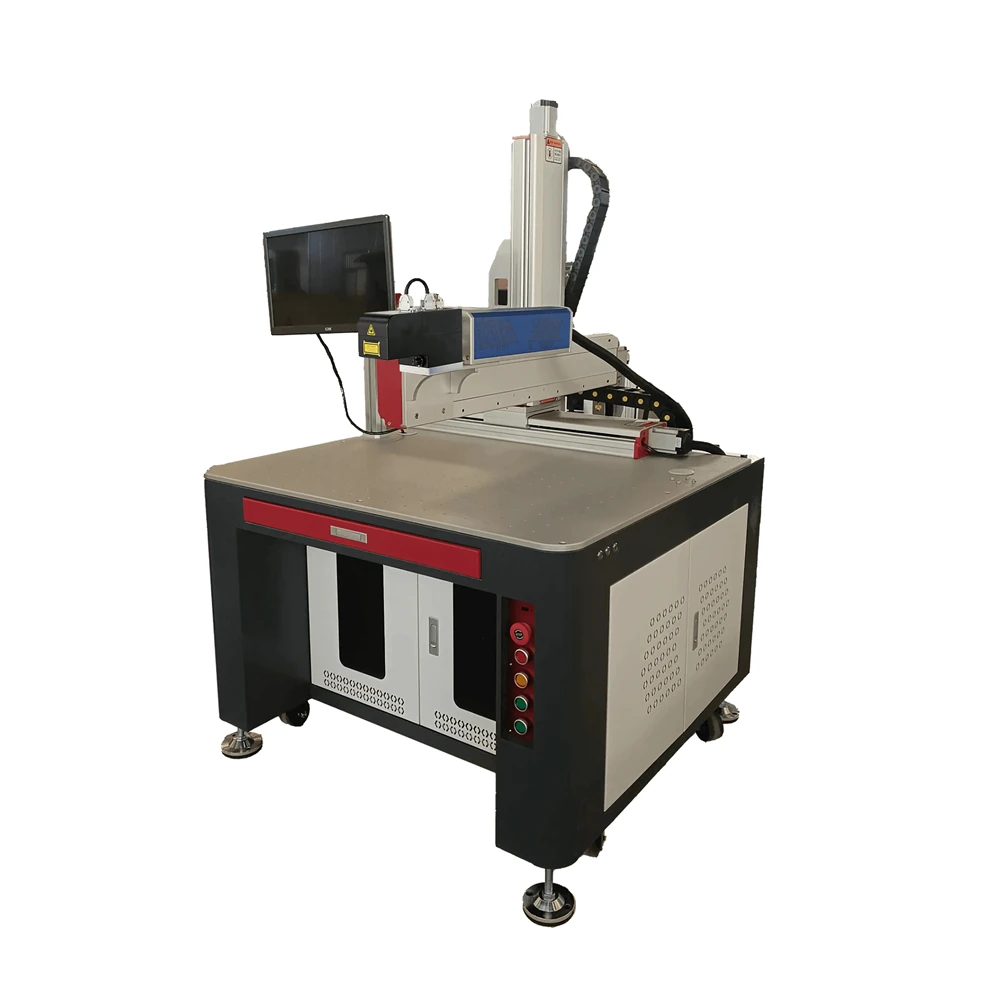
A much wider field for large flat parts and panels that would not fit a standard 300 mm marking area.
View model