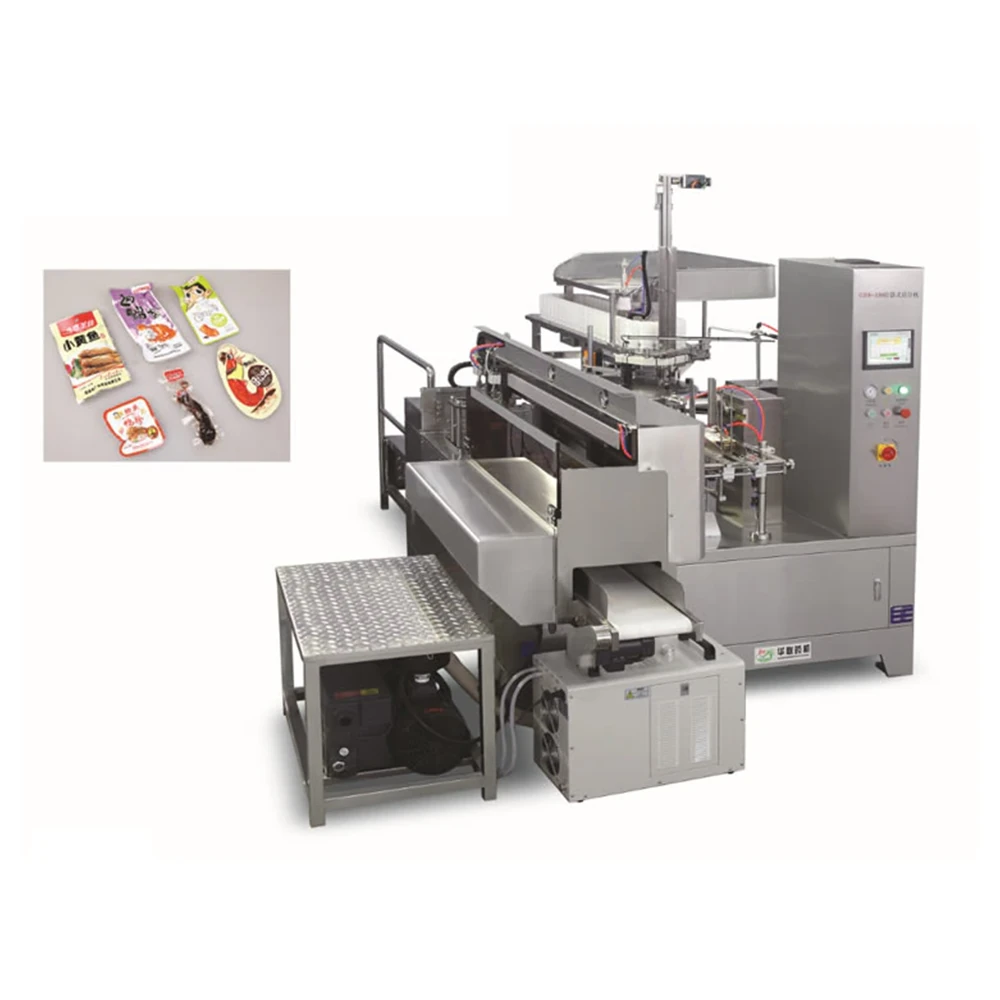
GD8-ZK100 Vacuum Packer (P29)
Compact rotary vacuum packer for liquids, pastes, powders, granules and block product.
View model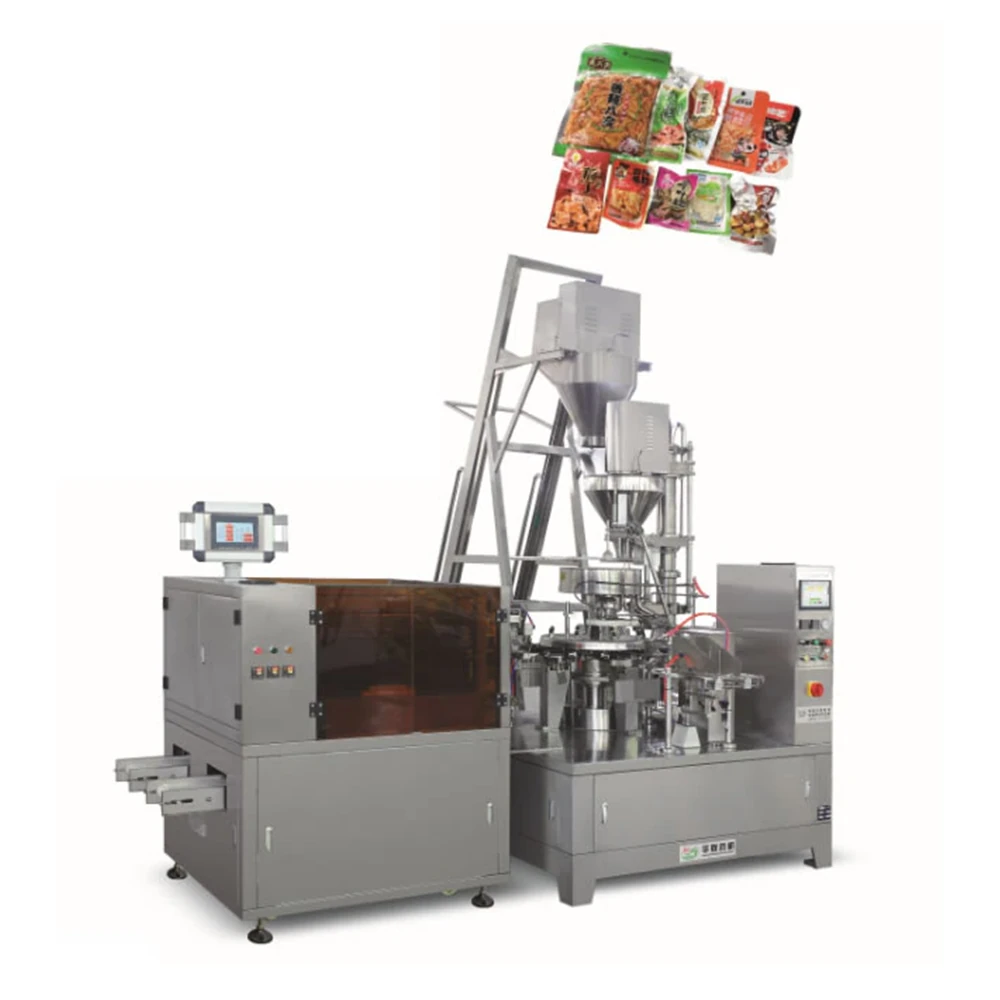
Pickles, mustard tuber and kelp shreds are sold as solid pieces in brine, and that is a harder filling problem than a free-flowing product. This unit is built around it: solids are metered first, brine or sauce is added to the set ratio, and the flat pouch is then evacuated and impulse sealed. Bag pick-up, bag opening, date printing, metering, vacuum and sealing all run automatically, at speeds of up to 60 packs per minute in pouch sizes from 70 to 150 mm wide and 80 to 200 mm long.
Three things separate a brined-solid packer from a general vacuum packer, and all three are handled here.
Figures are taken directly from the machine datasheet. Compressed air is supplied by the user.
| Parameter | HLGD-ZKJ-200 |
|---|---|
| Bag type | Flat pouch |
| Bag size | Width 70–150 mm, length 80–200 mm |
| Packing speed | Up to 60 packs per minute |
| Total power | 12.5 kW |
| Compressed air consumption | 0.6 m³/min, supplied by the user |
| Bag handling | Automatic pick-up and opening of the flat pouch |
| Marking | Automatic printing of production date and batch number |
| Sealing | Impulse heat sealing applied after evacuation |
| Metering | Solid pieces metered with brine or sauce added to the set ratio |
| Line composition | Metering, bag feeding, vacuum, sealing and output as one unit |
| Typical products | Pickles, mustard tuber, preserved vegetable, kelp shreds, snow vegetable, leaf mustard, side dishes |
Pouch dimensions, pack weight, solids ratio and line layout are confirmed before production. Send a filled sample pack and we will match the metering and the vacuum recipe to it.
The unit is made of four stations. This table shows what each one does for the three main product types in this market.
| Aspect | Metering Station | Bag Feed and Opening | Vacuum and Seal | Output and Washdown |
|---|---|---|---|---|
| Purpose | Deliver a repeatable dose of solid pieces with brine or sauce | Pick and open one flat pouch per cycle | Draw the air out and close the pouch mouth | Discharge packed pouches and keep the line clean |
| Whole pieces with brine | Solid dose metered first, brine added to the set ratio | Flat pouch 70–150 × 80–200 mm | Extended evacuation dwell for brine-filled packs | Conveyor output with drop trays below the stations |
| Shreds and kelp strands | Servo-controlled filling suited to strands and shreds | Same pouch range, slower cycle for difficult product | Longer dwell for air trapped between shreds | Removable chutes and open guards for rinse-down |
| Side dishes and sauces | Metered solid plus sauce in a second pass | Same pouch range | Dwell set to the sauce viscosity | Washdown between products |
| Throughput | Up to 60 packs per minute line speed | Matched to line speed | Dwell sets the achievable speed | Continuous |
| Key control point | Solids to liquid ratio | Pouch opening detection | Vacuum level and evacuation dwell | Cleaning between products |
Vacuum level and evacuation dwell are stored with the product recipe and set on the control interface. The achievable speed is always confirmed with your own product, because pack weight and brine content change how long the pouch takes to evacuate.
The three outcomes that matter most when packing brined vegetable products.
Because the solid dose is metered and the liquid added on top, every pouch shows a similar fill level and drained weight.
Impulse sealing applied after a properly set evacuation avoids the trapped-air failures that spoil wet packs in storage.
Bag pick-up, opening, date printing, metering, vacuum and sealing are handled by the machine, so the operator mainly monitors output.
The pouch follows the same route on every cycle, which is what keeps a wet pack consistent.
The filling station dispenses the set dose of solid pieces, such as cut mustard tuber or kelp shreds.
Brine or sauce is added to the set ratio, so the liquid content of the pack does not vary from pouch to pouch.
The flat pouch is picked from the magazine, opened, printed with date and batch and filled through the open mouth.
Air is drawn out to the recipe level, and an impulse seal closes the mouth before the pouch is discharged.
The product list this unit was configured around, all of them sold with brine or sauce.
Whole and cut mustard tuber and leaf mustard packed with the brine the product is cured in.
Shredded and stranded products such as kelp shreds and snow vegetable, filled by a metering system suited to wet strands.
Preserved vegetable with bamboo shoots and prepared side dishes that are packed with sauce for retail.
The same unit also suits other brined and pickled products where solid pieces are packed with a liquid or sauce fraction.
Delivery includes the documentation, spares and support needed to run a wet-pack line reliably.
The unit is tested before dispatch, and installation and layout guidance are provided for the metering, feeding and output stations.
A spare parts kit is supplied, covering the components most exposed to product and cleaning.
Major parts are replaced within the warranty period, with technical help continuing online afterwards.
Operation, cleaning and changeover are covered on video, and we help set the ratio and vacuum recipe for each product.
Products such as mustard tuber, preserved vegetable and kelp shreds are sold as solid pieces sitting in brine, so the pack needs a metered solid dose plus a controlled amount of liquid. This unit is configured around that filling problem rather than around free-flowing product.
The solids are metered first and the brine or sauce is added to the set ratio, so both parts of the pack are repeatable rather than varying with how the product happens to flow. The ratio is stored with the product recipe and recalled on changeover.
Flat pre-made pouches between 70 and 150 mm wide and 80 and 200 mm long. The pouches are picked and opened automatically, so the printed pouch is used as supplied.
Up to 60 packs per minute, which depends on the product and the pack weight. Heavier packs with more brine take longer to evacuate, so the achievable speed is confirmed on your product during the sample trial.
The filled pouch enters the vacuum station, where air is drawn out to the level set for the recipe, and the mouth is then closed by an impulse heat seal. Brined products need a longer evacuation dwell so gas escapes from between the solid pieces before the seal closes.
A total power supply of 12.5 kW and compressed air at 0.6 cubic metres per minute, which is supplied by the user. The layout is confirmed with the room plan so the metering, bag feeding and output stations fit the available floor.
Food contact parts are in stainless steel, the chutes and guards open for washdown, and drop trays collect product lost at the filling and sealing stations. The vacuum chamber is drained and wiped between shifts.
For free-flowing or block products rather than brined solids, compare the GD8-ZK100 configurations.
Compact rotary vacuum packer for liquids, pastes, powders, granules and block product.
View model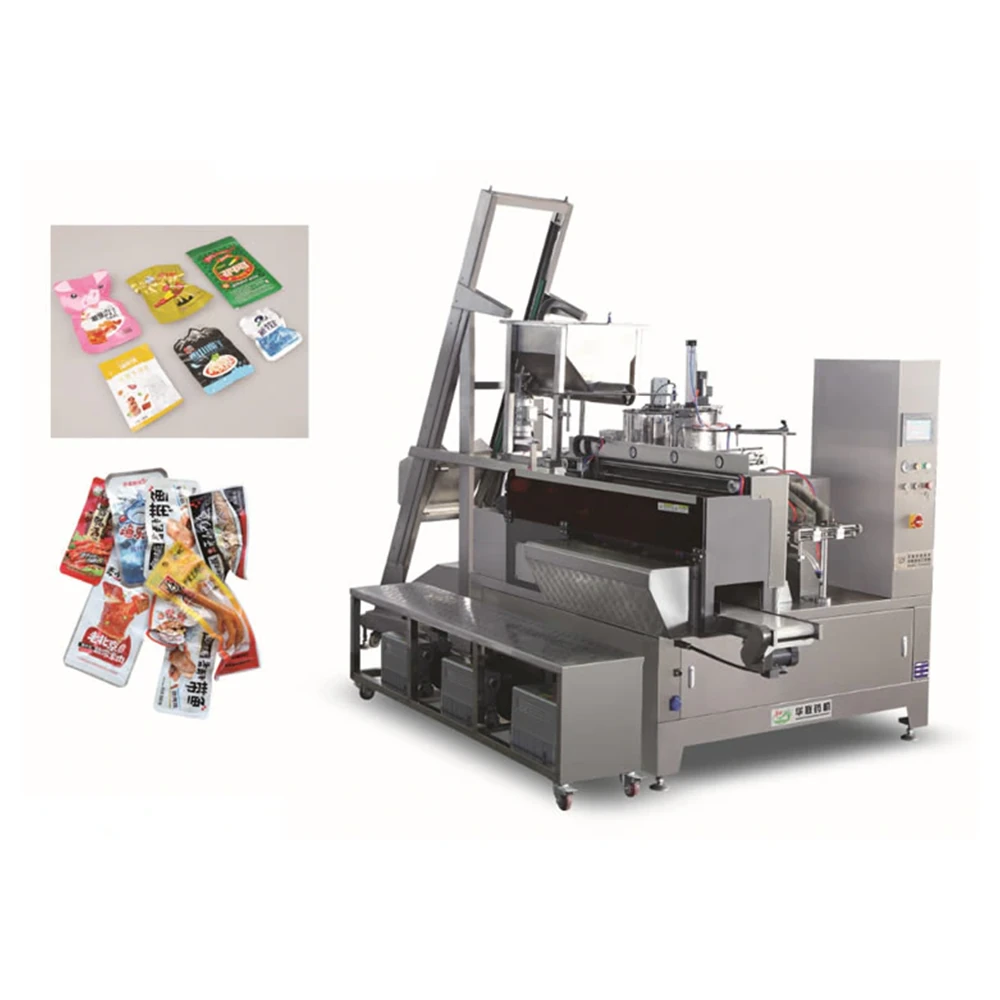
The same platform in a taller frame, for raised lines and elevated infeed.
View model
The full range with the vacuum and speed guide and the dosing comparison in one place.
View range