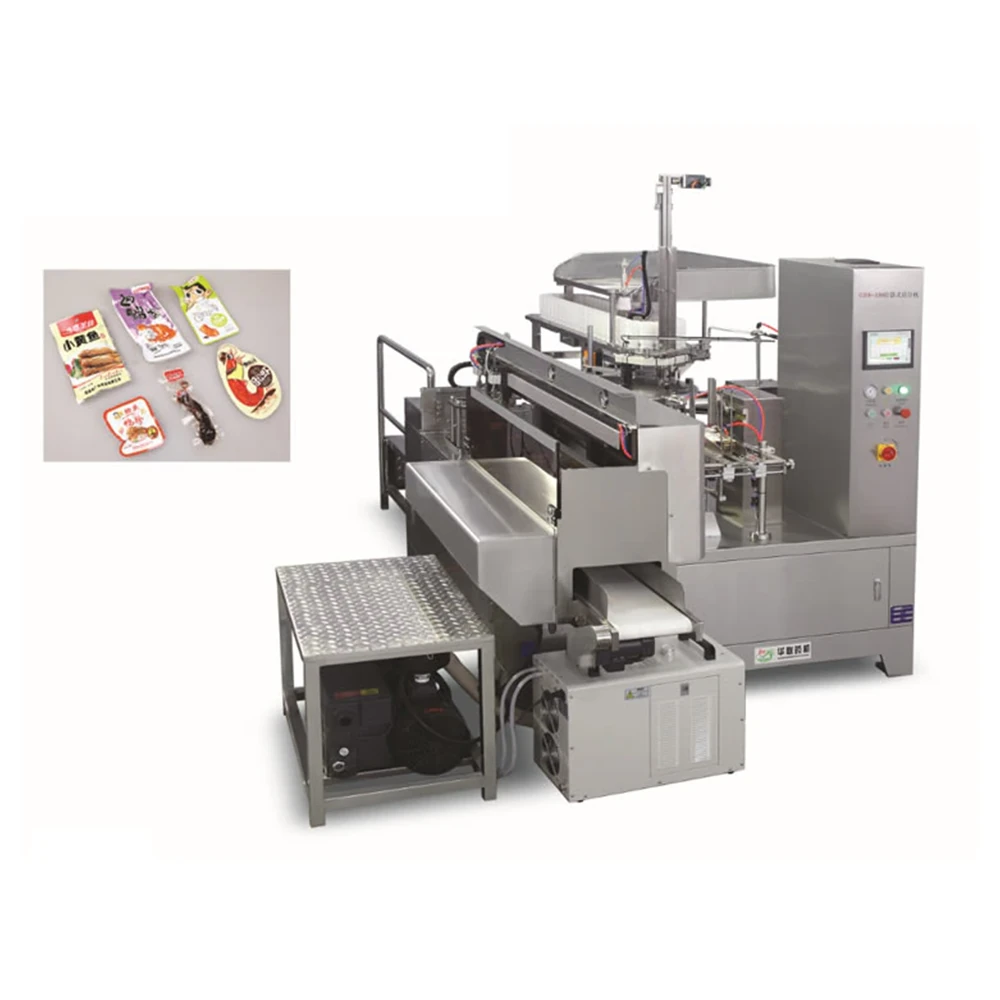
GD8-ZK100 Vacuum Packer (P29)
Compact rotary vacuum packer for pouches up to 200 × 105 mm, running 2,500–3,500 packs per hour on a low 3,540 mm footprint.
View detailsPre-made pouch vacuum packing removes the operator from the bag while keeping the product visible and shelf-ready. A robotic arm lifts a pouch, opens it, the dosing unit fills it, and the vacuum station draws the air out before an impulse seal closes the pouch. The same platform covers pickles in brine, shredded vegetables, cubed roots, powders, granules, liquids and pastes by changing only the dosing head. Output reaches 60 packs per minute, and the PLC withholds product whenever a pouch is missed.
The bag, not the product, is the constraint in vacuum packing. These machines are built around a pouch magazine and a rotary carousel so every pouch follows the same path every cycle.
A mechanical arm picks a single pouch, transfers it to the carousel and opens the mouth with suction. The printed, branded pouch is used as supplied, so no film forming or forming die is needed.
The filled pouch enters the vacuum station, where air is evacuated to the level set for the recipe, then an impulse heat seal closes the mouth. Sealing only after evacuation is what gives the pack its shelf life.
Swap the filling head and the same machine handles brine-packed solids, shreds, pastes, powders and granules. A separate top-up station keeps the solid to liquid ratio repeatable in every pouch.
Deeper vacuum and a longer evacuation dwell cost cycle time, but they are what stop air pockets from opening a seal on a pouch full of brine or shreds.
| Product family | Vacuum setting | Evacuation dwell | Dosing method | Output band |
|---|---|---|---|---|
| Whole pickles and brined vegetables | Deep | Extended | Volumetric cup with brine top-up | Towards the lower end of the cycle |
| Shredded pickle, sauerkraut, snow vegetable | Deep | Extended | Servo-driven solid filler with liquid top-up | Towards the lower end of the cycle |
| Cubed and diced root vegetables | Medium-high | Standard | Multi-head weigher | Full cycling speed |
| Powders and fine granules | Medium | Short | Auger or multi-head weigher | Full cycling speed |
| Liquids, sauces and pastes | Medium | Standard | Piston or servo volumetric filler | Full cycling speed |
| Mixed solid and sauce packs | Medium-high | Standard | Weigher plus sauce top-up | Full cycling speed |
Vacuum level and evacuation dwell are set on the operator interface and confirmed on your own product during a sample trial. The bands above describe the starting point for each product family; the final recipe is stored machine-side and recalled by product code.
Two configurations of the GD8-ZK100 rotary vacuum packer and a dedicated HLGD-ZKJ-200 unit for pickles and brined vegetables.
Compact rotary vacuum packer for pouches up to 200 × 105 mm, running 2,500–3,500 packs per hour on a low 3,540 mm footprint.
View details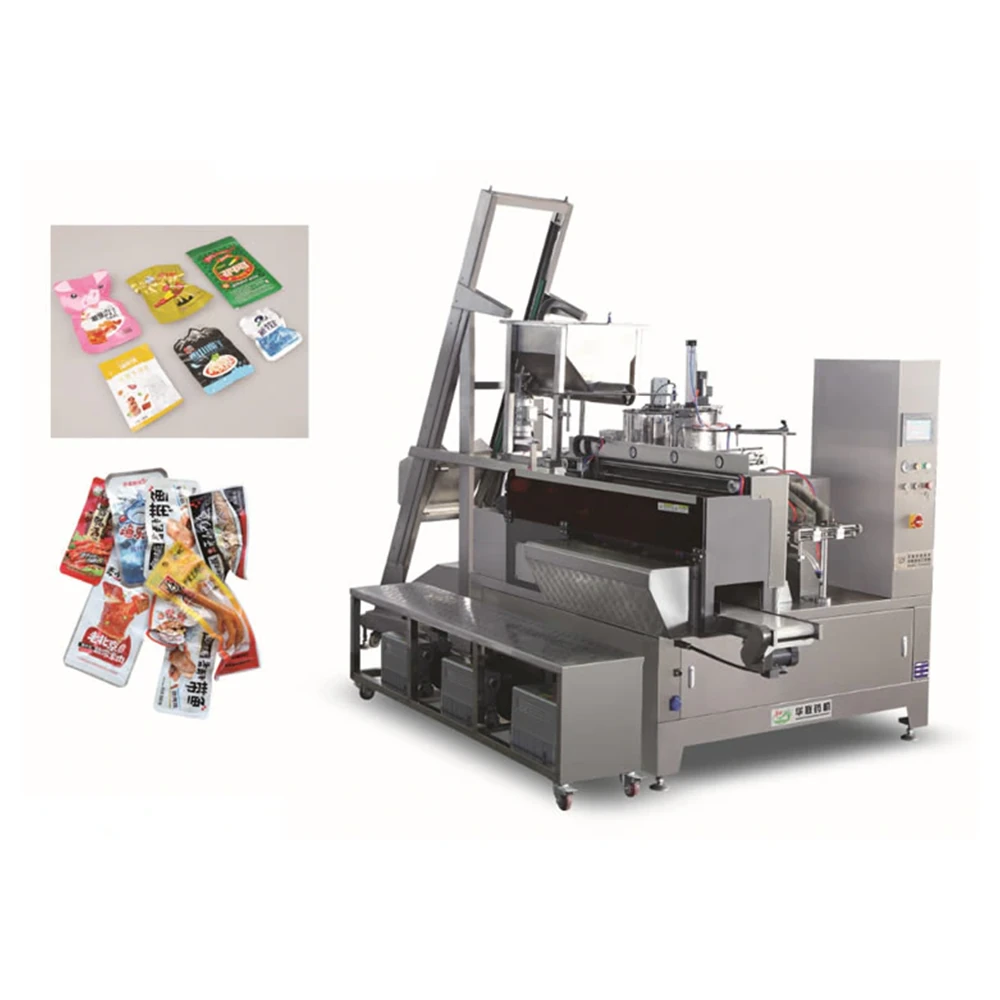
The same 2,500–3,500 packs per hour platform in a taller frame, giving extra headroom for the vacuum station and elevated infeed.
View details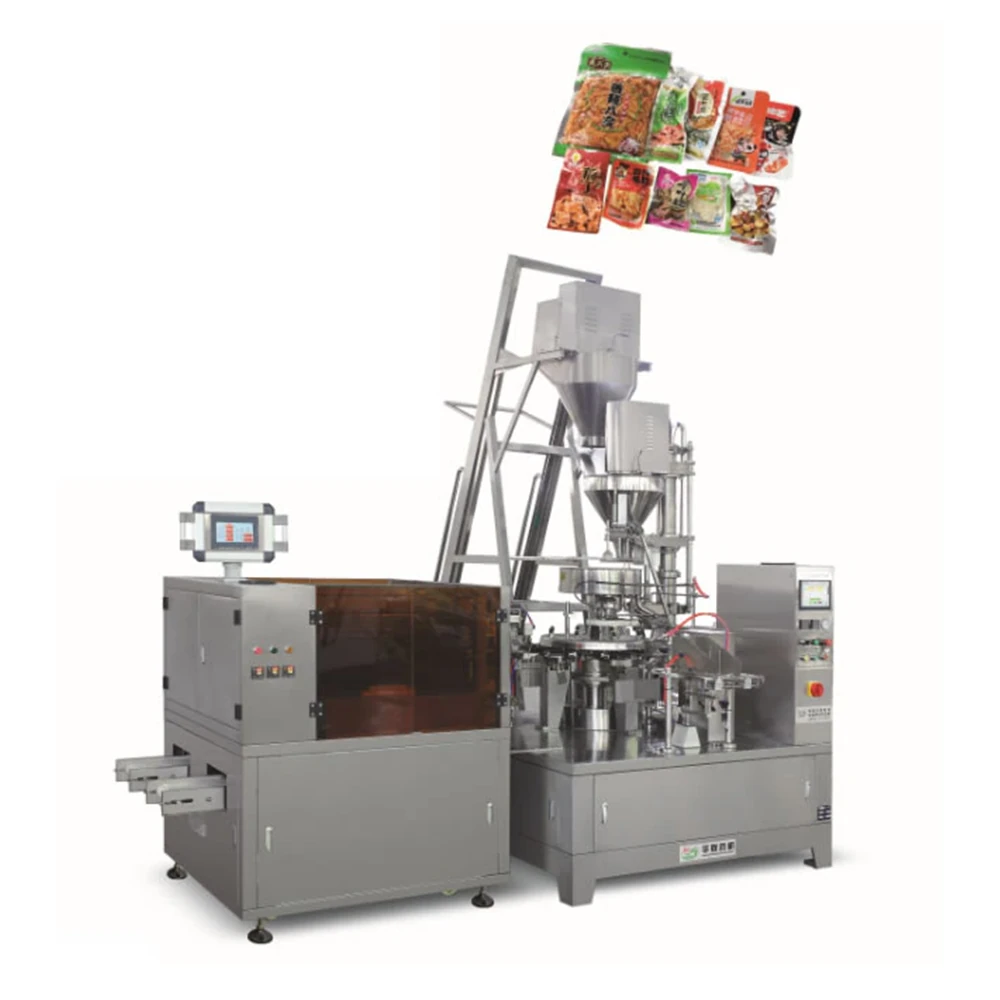
A metering and vacuum packing unit tuned for pickles, mustard tuber, kelp shreds and other brined products with high solids content.
View detailsAll three machines seal by impulse heat after vacuum. The differences that matter are pouch size, output and how much floor space the frame needs.
| Parameter | GD8-ZK100 (P29) | GD8-ZK100 (P32) | HLGD-ZKJ-200 |
|---|---|---|---|
| Model code | GD8-ZK100 | GD8-ZK100 | HLGD-ZKJ-200 |
| Packing capacity | 2,500–3,500 packs/h | 2,500–3,500 packs/h | ≤60 packs/min |
| Bag type | Pre-made pouch, automatically picked and opened | Flat pouch | |
| Bag size | Length ≤ 200 mm, width ≤ 105 mm | Width 70–150 mm, length 80–200 mm | |
| Sealing method | Impulse heat seal, applied after the vacuum is drawn | ||
| Dosing options | Liquid and paste filler, multi-head weigher, or automatic feeder for block product | Metered filling for solid pieces with brine or sauce | |
| Control | PLC with HMI monitoring, empty and missing bag detection, fault output | ||
| Power | 12.5 kW | 12.5 kW | 12.5 kW total |
| Supply | 380V three-phase four-wire, 50 Hz | As configured for the line | |
| Compressed air | 0.6–0.8 MPa at 0.2 m³/min | 0.6 m³/min, user supplied | |
| Dimensions (L × W × H) | 3540 × 2965 × 2080 mm | 4700 × 2965 × 3700 mm | Configured per line |
| Machine weight | 1500 kg | 1500 kg | Line dependent |
| Typical products | Liquids, pastes, powders, granules and block products in pre-made pouches | Pickles, mustard tuber, preserved vegetable, kelp shreds, snow vegetable | |
Dosing head, pouch magazine, print unit and discharge conveyor are specified with the order. Send a pouch sample and a bucket of product and we will confirm the filling method and the vacuum recipe before production.
The packer is the centre of the line, but the stations before and after it decide whether the pack is consistent.
Volumetric cups, a servo auger, a piston filler or a multi-head weigher feeds a repeatable dose. Brine, sauce or oil can be added at a separate top-up station to hold the solid to liquid ratio.
The robot arm takes one pouch from the magazine, transfers it onto the carousel and opens the mouth. Missing and unopened pouches are detected and rejected before product is dispensed.
The pouch enters the vacuum station, air is evacuated to the recipe value, and the impulse heat seal closes the mouth. Temperature, pressure and dwell are held constant pack to pack.
Production date and batch number are printed automatically, so traceability is applied inside the machine instead of on a separate station downstream.
Finished packs leave on a conveyor, optionally through a check and reject station or a weight checker before secondary packing and cartoning.
Stainless food contact parts, opening guards and drop trays make daily cleaning practical. The vacuum chamber is drained and wiped between shifts.
Sealed, compact packs travel further, store longer and present better on the shelf.



Mustard tuber, preserved vegetable, kelp shreds, snow vegetable and diced pickles packed with brine at a repeatable solids ratio.
Cubed roots, mixed vegetables and prepared ingredients vacuum packed to extend storage life and reduce freezer burn.
Pastes, sauces and dry powders in pre-made pouches, with a dosing head matched to viscosity and flow behaviour.
A robotic arm picks one pouch from the magazine, transfers it to the carousel and opens the mouth with suction cups. The dosing unit fills through the open mouth, then the pouch indexes to the vacuum and sealing stations before being discharged.
Dosing is matched to the product: volumetric cups or a piston filler for solid pieces with brine, a servo auger for shredded or powdered material, and a multi-head weigher for granules. Brine or sauce can be added in a separate top-up station so the solids to liquid ratio stays repeatable.
The machines are built around flat pre-made pouches up to 200 mm long and 105 mm wide on the GD8-ZK100, and 80-200 mm long by 70-150 mm wide on the HLGD-ZKJ-200. Stand-up, zipper and shaped pouches can be reviewed from a sample bag before an order is placed.
Both are set on the operator interface and confirmed during a sample trial. Products that trap air, or that carry brine, need a deeper vacuum and a longer dwell so gas escapes from the product before the seal closes. Once set, the values are stored with the product recipe.
Food contact parts are in stainless steel and the doors, guards and product chutes open for daily washdown. Drop trays collect product lost at the filling and sealing stations, and the vacuum chamber is drained and wiped between shifts.
Yes. The PLC monitors bag pick-up and fill, and if a pouch is missed or fails to open it outputs an alarm and withholds product and the seal, so material and pouches are not wasted.
A standard machine is built and tested before dispatch, with production time confirmed on the order. Support includes installation guidance, operator training material and lifetime online technical help with spare parts shipped by air express.
Prepare the product before packing with the fruit and vegetable washing machines, the filling machines or the sealing machines from the same division.
Washing, filling, sealing and vacuum packing are engineered on matching line heights and control platforms, which keeps integration and spare parts simple.